Adaptive materials
The source discusses materials responsive to heat or humidity, such as thermobimetals and certain hydrogels. Environmental response may inform components, but applying it to complete facades requires durability, safety, control and maintenance testing.
Ecological integration
Green roofs, shading and rainwater management can combine environmental and functional benefits when designed for the site. Check structural loads, waterproofing, water supply and maintenance. Biophilic design does not imply complete isolation from outdoor weather.
Architectural informatics
Information models, performance records and sensing support study of buildings over time. Envelope moisture or energy use can inform operational indicators, with sensor validation and privacy controls. Do not assume design software automatically learns from thousands of homes or diagnoses occupants.
Define need
Assess maturity
Test prototype
Validate application
Living building materials
The source explores biological materials and self-repair. These research directions have varying maturity. Crack closure in a test does not prove repair of a structurally damaged building. Applications require defined performance limits, standards and testing.
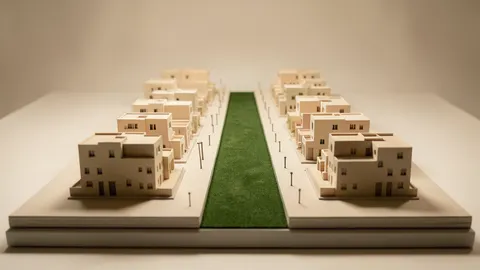
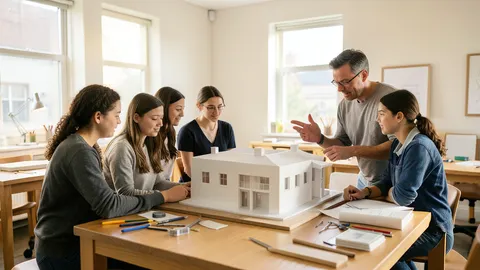
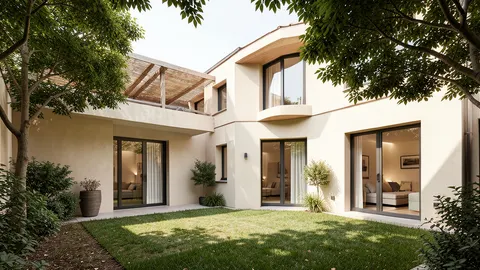
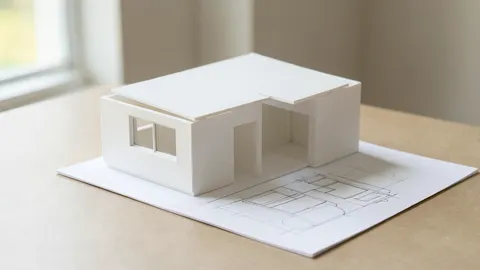
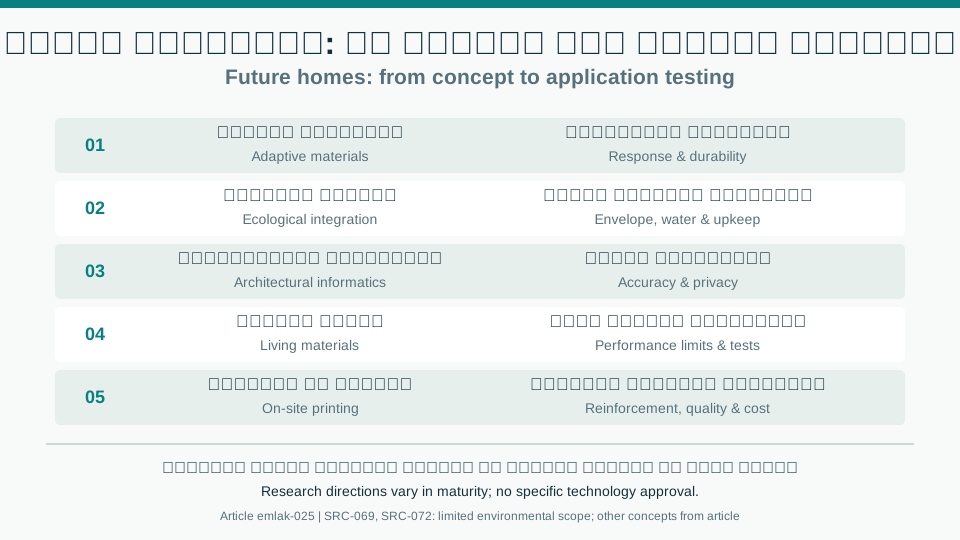
A visual reading of the article topic
- 01Adaptive materials
- 02Ecological integration
- 03Architectural informatics
- 04Living building materials
On-site printing
Construction printing may produce components or geometries differently from conventional methods. Assess materials, reinforcement, connections, quality control and whole-process costs. Carbon or cost reduction is not automatic. The source's 2035 vision is a scenario, not an engineering promise.
Decision review table
| Factor | Evidence to check |
|---|---|
| Adaptive materials | Response and durability |
| Ecological integration | Climate, water, maintenance |
| Informatics | Accuracy and privacy |
| Living materials and printing | Testing, maturity and delivery |
Practical workflow
Topics and source excerpts
| Topic | Excerpt from article |
|---|---|
| Adaptive materials | The source discusses materials responsive to heat or humidity, such as thermobimetals and certain hydrogels. |
| Ecological integration | Green roofs, shading and rainwater management can combine environmental and functional benefits when designed for the site. |
| Architectural informatics | Information models, performance records and sensing support study of buildings over time. |
| Living building materials | The source explores biological materials and self-repair. |
| On-site printing | Construction printing may produce components or geometries differently from conventional methods. |
| Source and limitations | Editorial expansion of the author's Emlak contribution; the historical text is retained. |
Source excerpts organized for comparison, not newly researched findings.
- Define need
- Assess maturity
- Test prototype
- Validate application
Source and limitations
Editorial expansion of the author's Emlak contribution; the historical text is retained. Named research institutions, companies and experimental results need specific papers or documents; this edition distinguishes research from available products without validating particular examples.
- US EPA: Using Green Roofs to Reduce Heat Islands — Shading and potential reductions in heat and cooling demand; no specific project savings, costs or maintenance established.
- US Department of Energy: Solar Photovoltaic System Design Basics — Building-integrated photovoltaics in roofs, windows and façades and electrical applications; technical and commercial barriers remain, no product approval.