Critique as a decision-improvement tool
Drawing critique is a structured review against program, owner objectives, site, function, comfort and coordination. It goes beyond opinions or rejection of the designer's work by identifying issues, evidence, effects and options. It may reveal circulation, privacy, daylight or service conflicts before changes become costly. Architectural review differs from specialist structural verification and official approval; scope and responsibilities should be defined.
Timing and inputs
Review can occur after programming, during concept alternatives, before detailed design or procurement, or when needs or site conditions change. Inputs include dated drawing versions, program, site information, available requirements, review objectives and necessary discipline documents. Prioritize safety, compliance and material clashes, then function, cost and aesthetics. Avoid freezing an entire project for a cosmetic issue that can be resolved within a defined scope.
Deliverables and closure verification
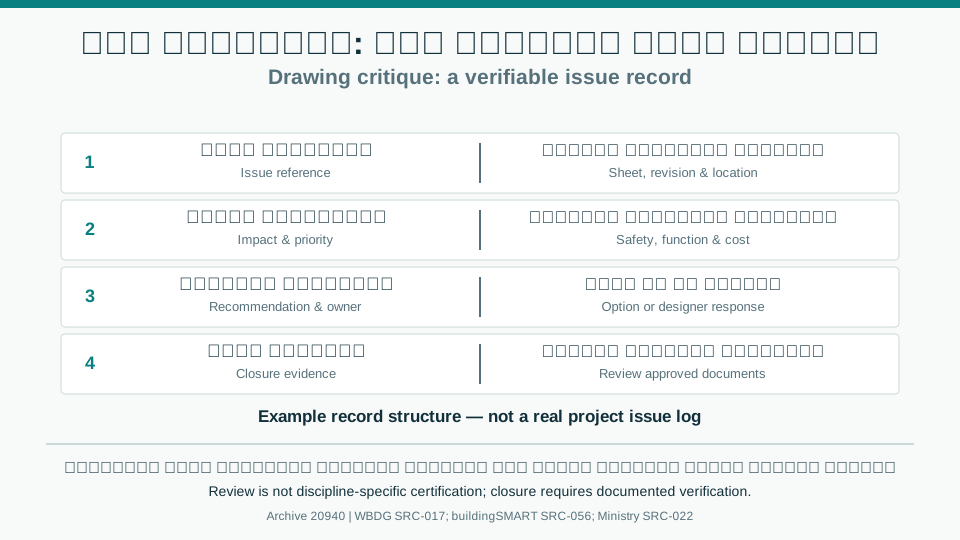
A reviewer provides an issue log with sheet number, location, description, impact, priority, recommendation and responsible respondent. Sketches or alternatives may be attached, distinguishing items requiring calculations or other specialist verification. The designer responds or revises approved documents and checks effects on other drawings. Close issues with evidence rather than delivery alone; retain versions and decisions. Review cannot guarantee eliminating every error or saving a specific amount, but can reduce unplanned-change risks.
Comparison and verification table
| Factor | Evidence or action |
|---|---|
| Inputs | Program, dated set and objectives |
| Review | Function, safety and coordination |
| Recommendations | Reference, impact and priority |
| Closure | Approved response, verification and record |
A visual reading of the article topic
- 01Critique as a decision-improvement tool
- 02Timing and inputs
- 03Deliverables and closure verification
- 04Comparison and verification table
Practical workflow
- 01 Define review scope
- 02 Provide relevant documents
- 03 Record issues and options
- 04 Verify designer response
Conceptual editorial diagram; not measured data.
Topics and source excerpts
| Topic | Excerpt from article |
|---|---|
| Critique as a decision-improvement tool | Drawing critique is a structured review against program, owner objectives, site, function, comfort and coordination. |
| Timing and inputs | Review can occur after programming, during concept alternatives, before detailed design or procurement, or when needs or site conditions change. |
| Deliverables and closure verification | A reviewer provides an issue log with sheet number, location, description, impact, priority, recommendation and responsible respondent. |
| Practical workflow | 01 Define review scope |
| Sources and limitations | Editorial adaptation based on the original WordPress archive; original source retained separately. |
Source excerpts organized for comparison, not newly researched findings.
Sources and limitations
Editorial adaptation based on the original WordPress archive; original source retained separately. The savings anecdote in the source is not a documented case in this adaptation or a financial guarantee; review scope and expertise for each project.
- WBDG: Meet Performance Objectives — Stakeholder needs, documented performance measures and staged reviews; no quantified savings.
- buildingSMART: BCF use-case guidance — Exchange of model issues, descriptions, status, comments and viewpoints; not causal evidence of error reduction.
- Ministry of Municipalities and Housing: Licensing documentation — Approved engineering documents, survey and soil study among service requirements; check project applicability.