Prevention before recycling
The source discusses municipal waste, composition, landfills and recycling. Integrated management begins with preventing waste, then reuse and repair, recycling or appropriate treatment, and safe disposal of residuals. Municipal, construction, industrial and hazardous waste differ in classification, transport and treatment needs. Removing waste from a site does not establish recycling.
Sorting and measurement
Source separation can reduce contamination and improve recovery where suitable collection and treatment exist. Some organics can be treated through appropriate composting or anaerobic digestion systems; paper, plastics, metals and glass vary by quality and markets. Hypothetically, of 100 tonnes generated, a recycler receives 40 tonnes and actually recovers 30: recovery is 30% of total generation, not 40%. Record rejects and final destinations.
Urban planning, construction and impacts
Architects can provide safe collection, sorting and access spaces and consider repairable or disassemblable materials where appropriate. Waste-to-energy and landfill options require evaluation of emissions, residues, costs and hierarchy fit. Special waste goes through appropriately authorized providers; do not burn or sort unknown hazardous materials at home. Compare options using consistent quantitative and environmental metrics.
Comparison and verification table
| Factor | Evidence or action |
|---|---|
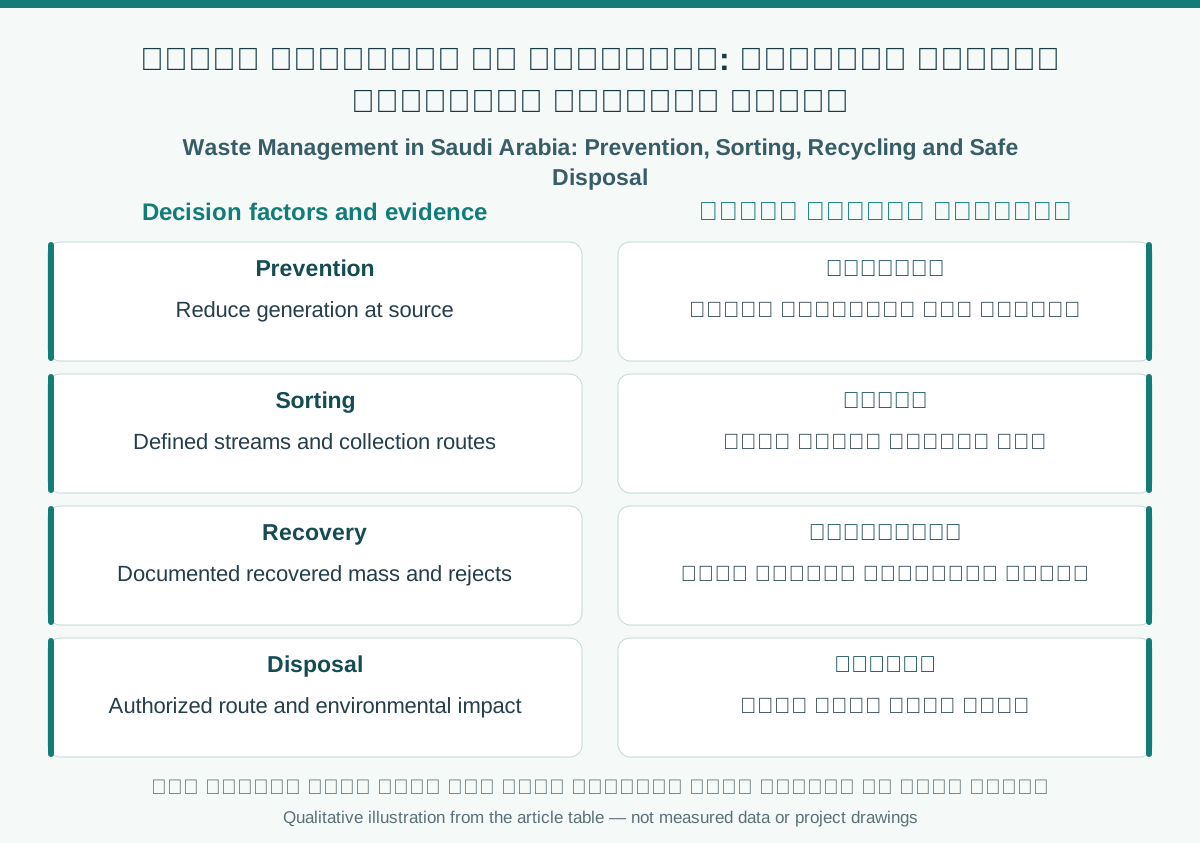
| Prevention | Reduce generation at source |
| Sorting | Defined streams and collection routes |
| Recovery | Documented recovered mass and rejects |
| Disposal | Authorized route and environmental impact |
A visual reading of the article topic
- 01Prevention before recycling
- 02Sorting and measurement
- 03Urban planning, construction and impacts
- 04Comparison and verification table
Practical workflow
- 01 Measure streams by type
- 02 Prevent and separate at source
- 03 Document treatment and recovery
- 04 Review residues and impact
Conceptual editorial diagram; not measured data.
Sources and limitations
Editorial adaptation based on the original WordPress archive; original source retained separately. Waste volumes, recycling rates, savings, emissions and project dates in the 2021 source need comparable official data. The example is hypothetical, not current Saudi performance.
Topics and source excerpts
| Topic | Excerpt from article |
|---|---|
| Prevention before recycling | The source discusses municipal waste, composition, landfills and recycling. |
| Sorting and measurement | Source separation can reduce contamination and improve recovery where suitable collection and treatment exist. |
| Urban planning, construction and impacts | Architects can provide safe collection, sorting and access spaces and consider repairable or disassemblable materials where appropriate. |
| Practical workflow | 01 Measure streams by type |
| Sources and limitations | Editorial adaptation based on the original WordPress archive; original source retained separately. |
| References and limitations | Material-management guidance prioritizes prevention and reuse, followed by appropriate sorting, recycling or recovery. |
Source excerpts organized for comparison, not newly researched findings.
References and limitations
Material-management guidance prioritizes prevention and reuse, followed by appropriate sorting, recycling or recovery. Verify Saudi waste law independently; this is not a statement of Saudi statutory hierarchy.
The following references support selected topics in the article.
- EPA Non-Hazardous Materials and Waste Management Hierarchy
- EPA Sustainable Materials Management Basics