Air conditioning is more than cooling
The source discusses temperature, humidity and airflow. One temperature or humidity target does not fit every building; comfort goals depend on use, activity, climate and design requirements. Cooling differs from ventilation: recirculation does not guarantee adequate outdoor air, and filtration and humidity control require specialist design and operation.
Comparing HVAC systems
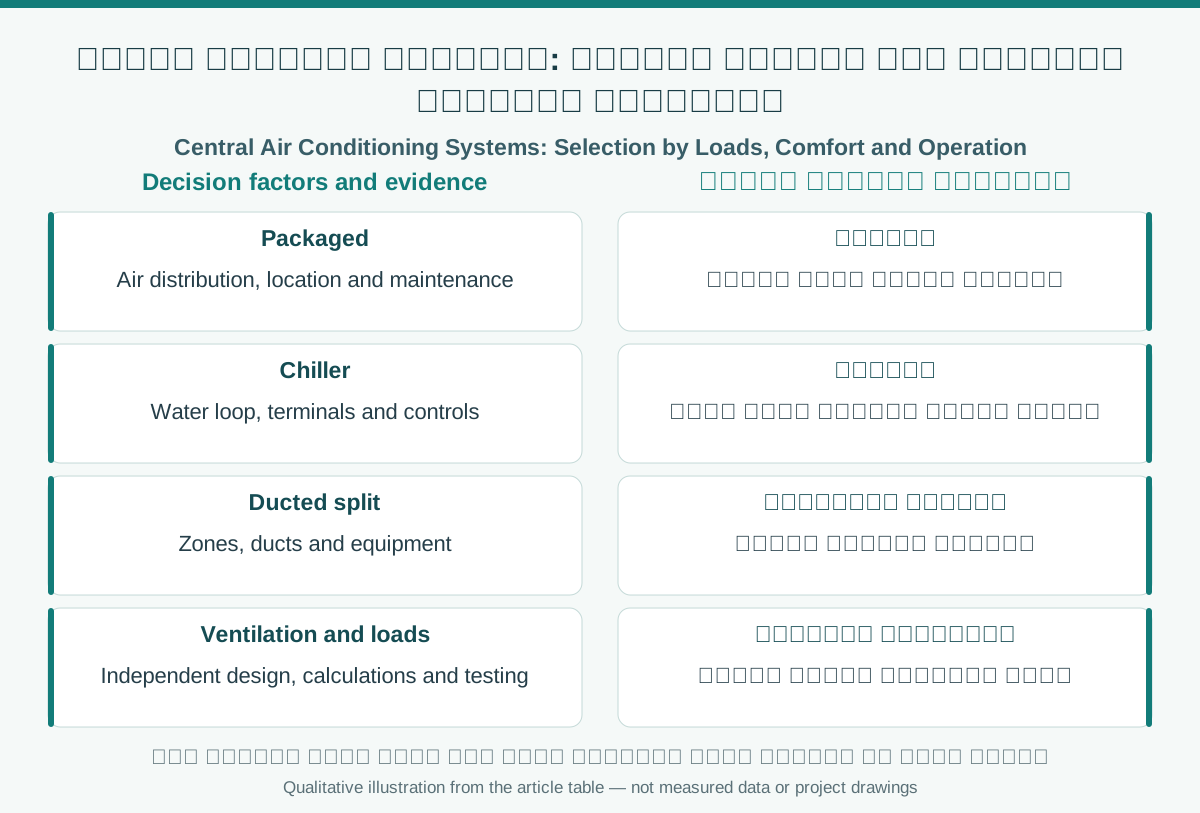
Packaged units combine cooling components in an assembly and may distribute air through ducts; chillers supply chilled water to air handlers or terminals. Ducted splits use indoor units linked to outdoor equipment and may serve zones through ducts. Zoning and outdoor-air capability depend on design, so independent control or ventilation cannot be assumed from the system name.
Loads, costs and commissioning
HVAC engineers calculate loads using climate, orientation, glazing, insulation, infiltration, occupancy, lighting, equipment and ventilation, distinguishing sensible and latent loads as needed. Floor area alone cannot determine capacity. Compare part-load efficiency, equipment and duct space, noise, maintenance and life-cycle costs. Verify applicable air and water balancing, condensate drainage, controls and ventilation before handover.
Decision review table
| Factor | Evidence or action |
|---|---|
| Packaged | Air distribution, location and maintenance |
| Chiller | Water loop, terminals and controls |
| Ducted split | Zones, ducts and equipment |
| Ventilation and loads | Independent design, calculations and testing |
A visual reading of the article topic
- 01Air conditioning is more than cooling
- 02Comparing HVAC systems
- 03Loads, costs and commissioning
- 04Decision review table
Practical workflow
- 01 Define use and climate
- 02 Calculate loads with specialist
- 03 Compare systems and lifecycle
- 04 Commission and test ventilation
Conceptual editorial diagram; not measured data.
Sources and limitations
Editorial adaptation based on the original WordPress archive; original source retained separately. Humidity, capacity, area, price and efficiency claims in the 2021 article are not universal specifications. Load calculations, technical review and applicable requirements are necessary; no mechanical design is provided.
Topics and source excerpts
| Topic | Excerpt from article |
|---|---|
| Air conditioning is more than cooling | The source discusses temperature, humidity and airflow. |
| Comparing HVAC systems | Packaged units combine cooling components in an assembly and may distribute air through ducts; chillers supply chilled water to air handlers or terminals. |
| Loads, costs and commissioning | HVAC engineers calculate loads using climate, orientation, glazing, insulation, infiltration, occupancy, lighting, equipment and ventilation, distinguishin… |
| Practical workflow | 01 Define use and climate |
| Sources and limitations | Editorial adaptation based on the original WordPress archive; original source retained separately. |
| References and limitations | Determine cooling loads from building, climate and operations; compare suitable systems by performance, distribution, maintenance and operating cost rather… |
Source excerpts organized for comparison, not newly researched findings.
References and limitations
Determine cooling loads from building, climate and operations; compare suitable systems by performance, distribution, maintenance and operating cost rather than nameplate capacity alone.
The following references support selected topics in the article.
- DOE Consumer Central Air Conditioners and Heat Pumps
- DOE Purchasing Energy-Efficient Residential Central Air Conditioners
- DOE About Building Energy Modeling
- EPA Indoor Air Quality