
Connectivity is not absence of boundaries
The article compares gated communities with neighborhoods integrated into the city. Some households may prefer controlled access and privacy, while connected neighborhoods can offer easier access to services, transport and social opportunities. No single model fits everyone; design gradients between public, semi-public and private spaces to balance movement, privacy and safety.
Services, walking and diversity
Test integrated neighborhoods through walking networks, cycle routes, shade, accessibility and access to schools, shops and amenities. Map proximity is insufficient when roads impede access. Compare actual journey times, route quality and service capacity, defining maintenance responsibilities and funding before handover.
Digital connectivity serving residents
Digital systems may coordinate maintenance requests, resource use and community communication. Connectivity or sensor counts do not establish smart-neighborhood success; make services accessible to non-app users, minimize and protect collected data, and maintain services during outages. Measure response times, resident satisfaction and public-space use.
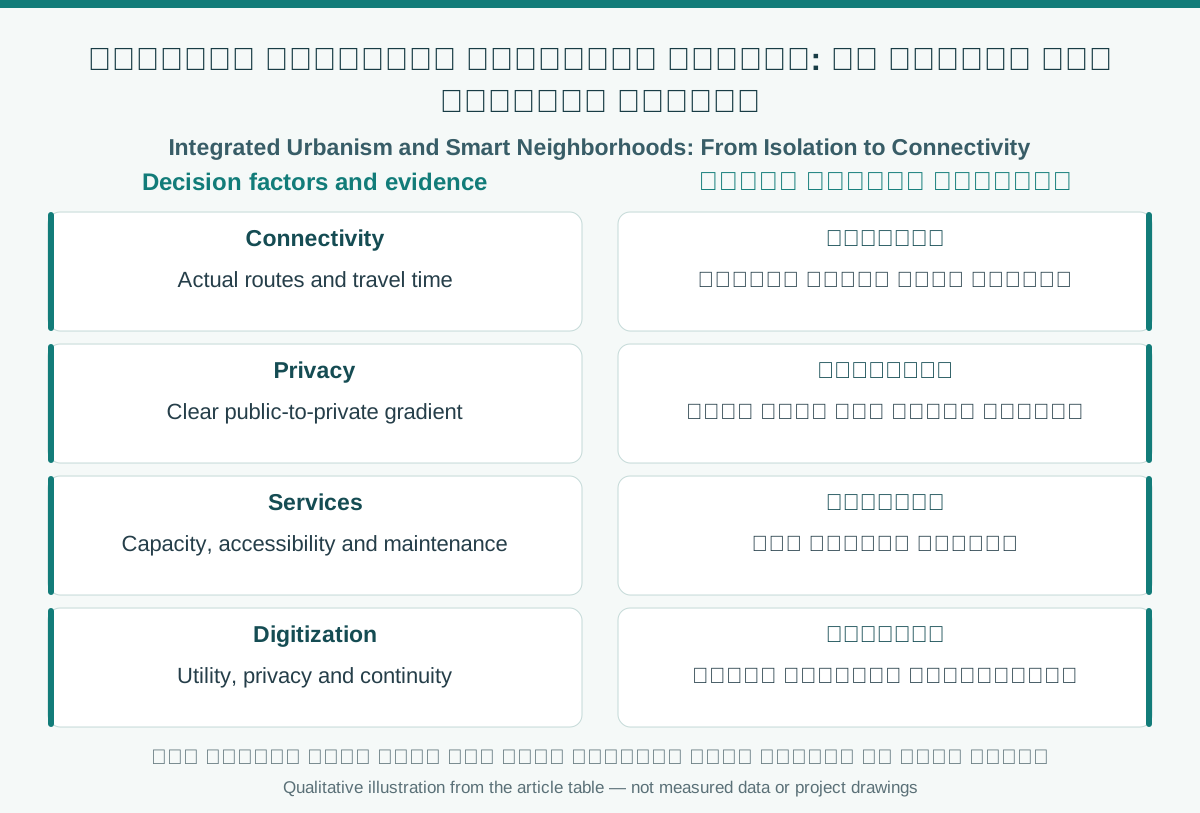
Decision review table
| Factor | Evidence or action |
|---|---|
| Connectivity | Actual routes and travel time |
| Privacy | Clear public-to-private gradient |
| Services | Capacity, accessibility and maintenance |
| Digitization | Utility, privacy and continuity |
A visual reading of the article topic
- 01Connectivity is not absence of boundaries
- 02Services, walking and diversity
- 03Digital connectivity serving residents
- 04Decision review table
Practical workflow
- 01 Understand residents
- 02 Analyze movement networks
- 03 Design services and boundaries
- 04 Test urban and digital performance
Conceptual editorial diagram; not measured data.
Sources and limitations
Editorial development based on the original Emlak source; previous text retained. Named projects, delivery status and connectivity adoption require specific documentation. The article does not assert that all Saudi households have shifted to one housing model.
Topics and source excerpts
| Topic | Excerpt from article |
|---|---|
| Connectivity is not absence of boundaries | The article compares gated communities with neighborhoods integrated into the city. |
| Services, walking and diversity | Test integrated neighborhoods through walking networks, cycle routes, shade, accessibility and access to schools, shops and amenities. |
| Digital connectivity serving residents | Digital systems may coordinate maintenance requests, resource use and community communication. |
| Practical workflow | 01 Understand residents |
| Sources and limitations | Editorial development based on the original Emlak source; previous text retained. |
| References and limitations | Evaluate neighborhoods by actual time and mode of access, and assess digital security rather than connectivity alone. |
Source excerpts organized for comparison, not newly researched findings.
References and limitations
Evaluate neighborhoods by actual time and mode of access, and assess digital security rather than connectivity alone.
The following references support selected topics in the article.
- ITF Urban Access Framework
- NIST IR 8425 public abstract