Plan vertical transportation before choosing technology
The source discusses smart elevators, group controls and destination dispatch. Begin with building use, population, floor distribution, peak traffic, waiting times, accessibility and service capacity. Destination control can group passengers with related destinations and reduce some stops, but outcomes depend on traffic, car count, capacity, speed and logic. Compare options through traffic simulation or specialist studies rather than fixed savings assumptions.
Monitoring without bypassing safety systems
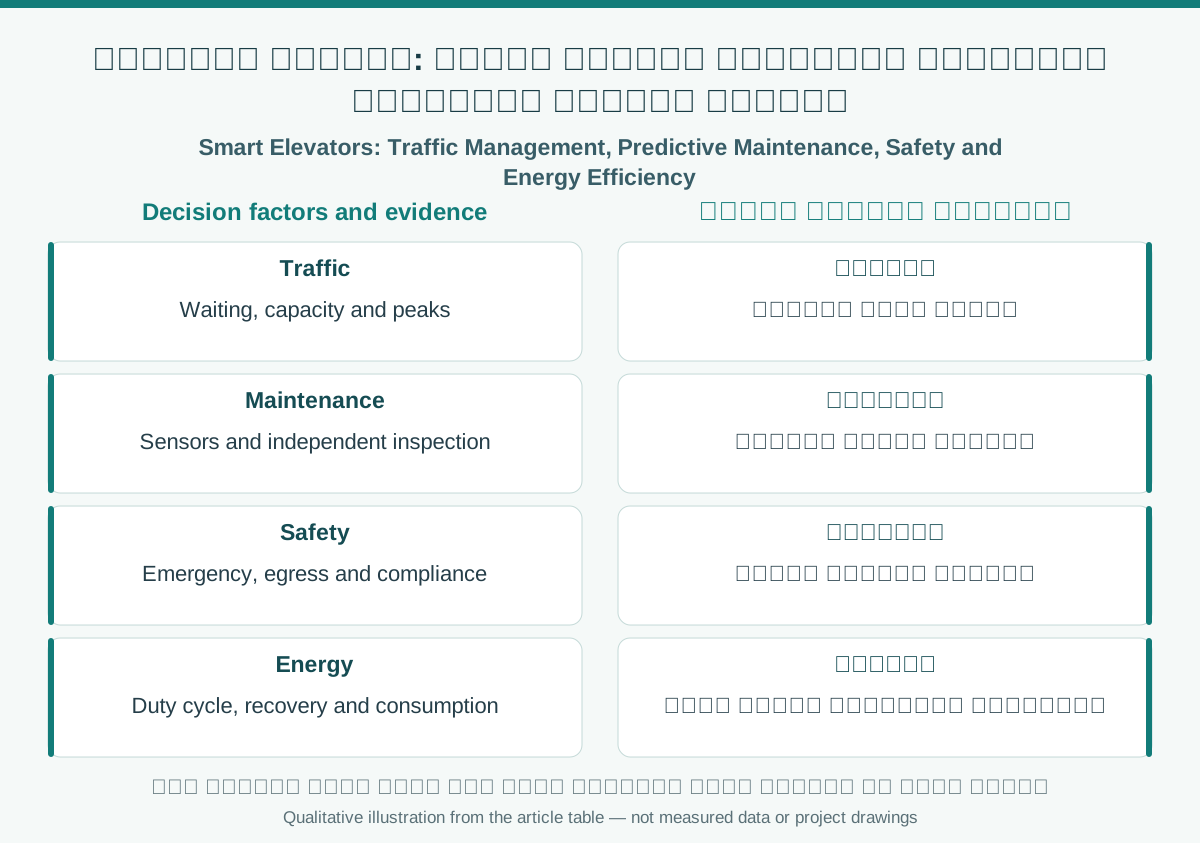
Some systems record vibration, motor temperature, door events and other signals to identify maintenance indicators. Predictions do not detect all faults or replace periodic inspection, independent safeguards and required testing. Review data quality, false alerts, permissions, cybersecurity and network-outage operation. Specialists establish rescue, emergency, fire-system integration and accessibility requirements for the building and applicable rules.
Energy performance and emerging technology
Elevators may benefit from variable-speed control, energy recovery during braking in suitable systems and reduced idle lighting or ventilation where permitted. Evaluate actual duty cycles and maintenance cost. The source also discusses cable-free travel, horizontal movement and magnetic levitation; distinguish concepts and prototypes from proven, approved systems with local service support. Verify shaft geometry, loads, services and warranties before procurement.
Comparison and verification table
| Factor | Evidence or action |
|---|---|
| Traffic | Waiting, capacity and peaks |
| Maintenance | Sensors and independent inspection |
| Safety | Emergency, egress and compliance |
| Energy | Duty cycle, recovery and consumption |
A visual reading of the article topic
- 01Plan vertical transportation before choosing technology
- 02Monitoring without bypassing safety systems
- 03Energy performance and emerging technology
- 04Comparison and verification table
Practical workflow
- 01 Analyze building traffic
- 02 Compare systems and simulations
- 03 Review safety and maintenance
- 04 Commission and verify performance
Conceptual editorial diagram; not measured data.
Sources and limitations
Editorial adaptation based on the original WordPress archive; original source retained separately. Historical efficiency percentages and emerging technology claims need test, manufacturer and authority verification; they are not specifications or safety guarantees.
Topics and source excerpts
| Topic | Excerpt from article |
|---|---|
| Plan vertical transportation before choosing technology | The source discusses smart elevators, group controls and destination dispatch. |
| Monitoring without bypassing safety systems | Some systems record vibration, motor temperature, door events and other signals to identify maintenance indicators. |
| Energy performance and emerging technology | Elevators may benefit from variable-speed control, energy recovery during braking in suitable systems and reduced idle lighting or ventilation where permit… |
| Practical workflow | 01 Analyze building traffic |
| Sources and limitations | Editorial adaptation based on the original WordPress archive; original source retained separately. |
| References and limitations | SASO publishes a dedicated elevator technical regulation. |
Source excerpts organized for comparison, not newly researched findings.
References and limitations
SASO publishes a dedicated elevator technical regulation. Verify the applicable Arabic text and inspection, maintenance, safety and accessibility provisions; analytics do not replace required inspections.
The following references support selected topics in the article.
- SASO Technical Regulation for Elevators Used in Buildings and Installations
- Saudi General Building Code SBC 201 (2024)
- Saudi Fire Protection Code SBC 801 (2024)