What readiness means
An AI-ready building need not run AI for every function. It needs upgradeable, interoperable infrastructure and reliable data. Define network, power, cable routes and service access before purchasing systems. Enable future applications without unnecessary reconstruction.
Data and use cases
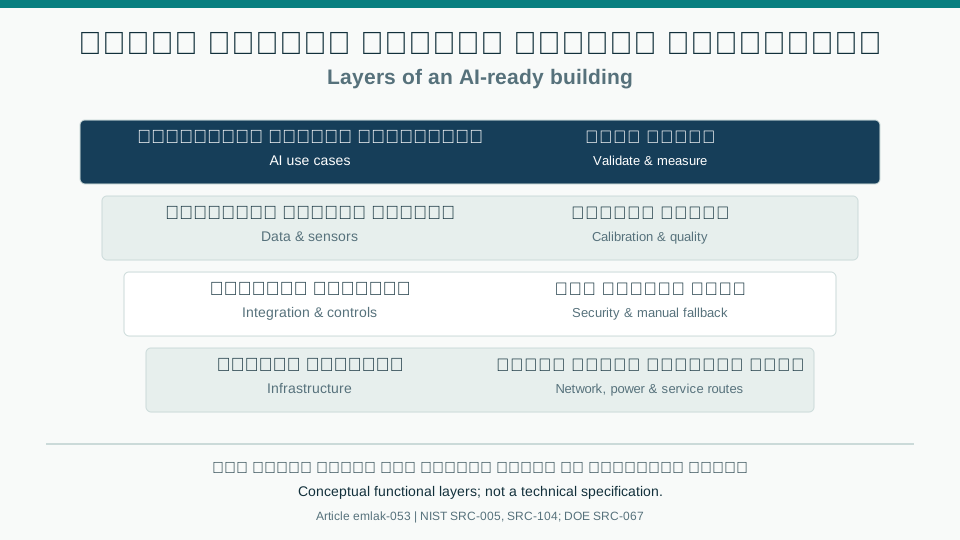
Place sensors by measurement purpose, defining calibration, timestamps and point documentation. Start with HVAC consumption and anomaly monitoring. Compare against a matched baseline, considering false alerts, user comfort and hardware and servicing costs. Prediction accuracy does not automatically equal financial savings.
Security and operation
Define access, data retention, upgrades and manual fallback. Use the NIST AI risk framework and an operations and maintenance measurement approach. For critical functions test outages, fallback and human controls. Prepare training and asset documentation before handover.
Decision review table
| Factor | Evidence to check |
|---|---|
| Infrastructure | Networks, power, maintenance |
| Data | Calibration and quality |
| Integration | Interfaces and fallback |
| Performance | Baseline and measured outcomes |
A visual reading of the article topic
- 01What readiness means
- 02Data and use cases
- 03Security and operation
- 04Decision review table
Practical workflow
- Define use case
- Prepare data
- Test operation
- Measure impact
References and limitations
Topics and source excerpts
| Topic | Excerpt from article |
|---|---|
| What readiness means | An AI-ready building need not run AI for every function. |
| Data and use cases | Place sensors by measurement purpose, defining calibration, timestamps and point documentation. |
| Security and operation | Define access, data retention, upgrades and manual fallback. |
| References and limitations | Editorial expansion of the author's Emlak contribution; the previous text is retained. |
Source excerpts organized for comparison, not newly researched findings.
Editorial expansion of the author's Emlak contribution; the previous text is retained. References support methodology, not implementation specifications or guaranteed savings.
- NIST: AI Risk Management Framework — Voluntary framework for design, development, use and evaluation; not proof of a product's performance.
- US Department of Energy: Energy Management Information System Capabilities — Meter analytics, fault detection, controls, measurement and verification; no building-specific savings established.
- NIST IR 8425: Consumer IoT Cybersecurity — Whole-product cybersecurity outcomes; not evidence of performance for a specific device or smart brick.