
Step one: identify a measurable gap
The article proposes beginning with practice deficiencies rather than a tool catalog. Choose a process such as comment coordination, version control or model review, measuring cycle time, rework and error causes. Distinguish training gaps from procedural or input-quality problems; process changes may resolve an issue without new software.
Step two: stage a pilot
Define one use case, a small team, time boundary, outputs and success criteria before piloting. Review existing-tool integration, interoperability, data ownership, security, training and support costs. Preserve a baseline and rollback option; do not migrate the entire firm before validation. Illustratively, an equivalent review taking four hours instead of five saves one hour, or 20%, before training, costs and quality effects.
Step three: user adoption and impact
Involve users in workflow design and training, recording issues, adoption and quality outcomes rather than treating license counts as success. Compare pilot results with the baseline under equivalent conditions and ensure rework has not shifted downstream. Scale, adapt or stop based on net benefit and risks; assign ownership of support, documentation and updates.
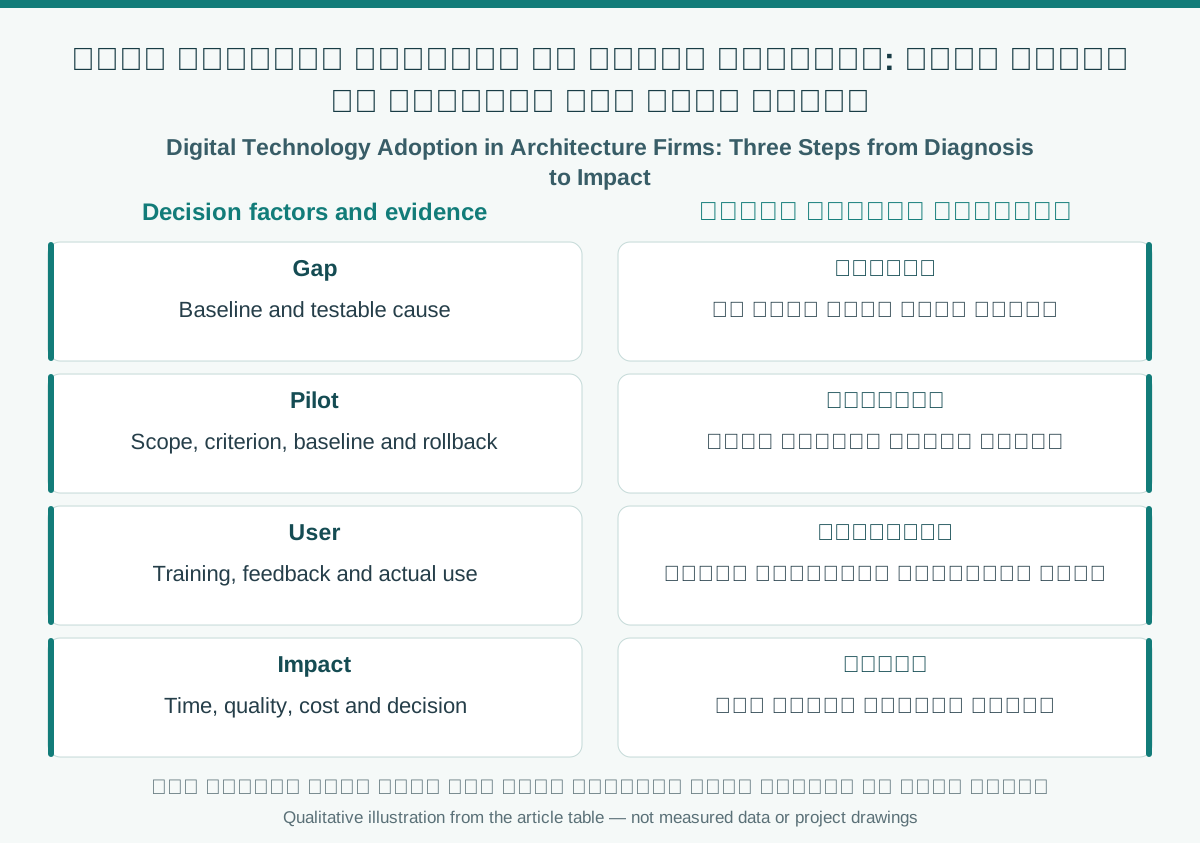
Comparison and verification table
| Factor | Evidence or action |
|---|---|
| Gap | Baseline and testable cause |
| Pilot | Scope, criterion, baseline and rollback |
| User | Training, feedback and actual use |
| Impact | Time, quality, cost and decision |
A visual reading of the article topic
- 01Step one: identify a measurable gap
- 02Step two: stage a pilot
- 03Step three: user adoption and impact
- 04Comparison and verification table
Practical workflow
- 01 Diagnose problem
- 02 Define bounded pilot
- 03 Test with users
- 04 Decide scaling using evidence
Conceptual editorial diagram; not measured data.
Sources and limitations
Editorial adaptation based on the original WordPress archive; original source retained separately. The numerical example is hypothetical. Generalizations about firm productivity, adoption and implementation durations from 2021 require current evidence; no universal success timeline exists.
Topics and source excerpts
| Topic | Excerpt from article |
|---|---|
| Step one: identify a measurable gap | The article proposes beginning with practice deficiencies rather than a tool catalog. |
| Step two: stage a pilot | Define one use case, a small team, time boundary, outputs and success criteria before piloting. |
| Step three: user adoption and impact | Involve users in workflow design and training, recording issues, adoption and quality outcomes rather than treating license counts as success. |
| Practical workflow | 01 Diagnose problem |
| Sources and limitations | Editorial adaptation based on the original WordPress archive; original source retained separately. |
| References and limitations | Define verifiable information exchange requirements and measure limited pilot results before scaling. |
Source excerpts organized for comparison, not newly researched findings.
References and limitations
Define verifiable information exchange requirements and measure limited pilot results before scaling. The three-step framework is editorial, not an observed outcome.
The following references support selected topics in the article.
- buildingSMART — Information Delivery Specification
- buildingSMART — openBIM
- NIST AI RMF Playbook