

Use cases
The source presents AI as a tool for property management, home search and lead generation. Applications include analytics, prediction, classification, recommendations and content generation. Models differ in purpose and inputs; learning from data does not mean understanding every property decision or operating without oversight. Start with a defined question, such as reducing search time or improving space allocation.
Property operations and discovery
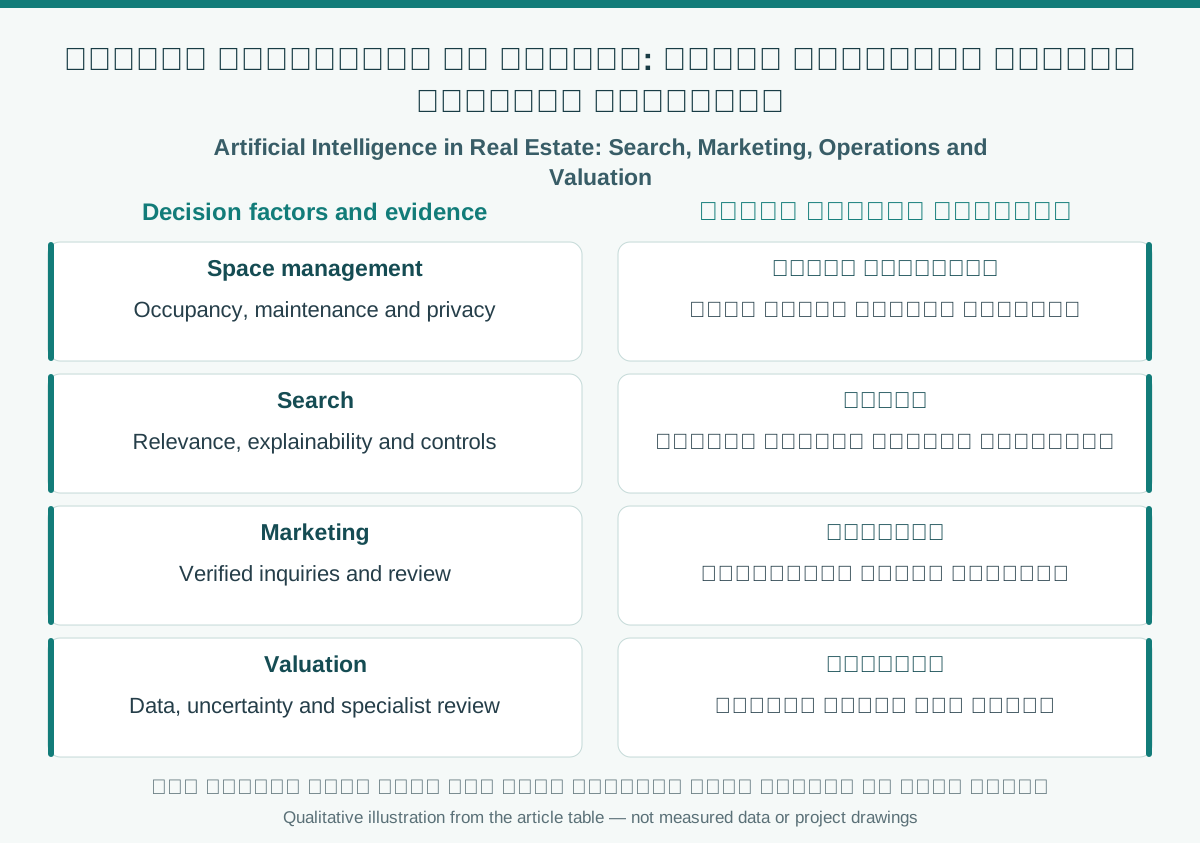
Occupancy, sensor and maintenance data may reveal use patterns or prioritize inspections if measurement and privacy are managed. Search and recommendation engines can rank properties against stated needs but may reflect bias or exclude important options; allow users to adjust criteria and see alternatives. Communication tools can organize inquiries and follow-ups without fabricating listing information or using personal data without an appropriate basis.
Test value and control risks
Link outputs to sources and data dates and compare with a baseline workflow. Automated valuation requires review of transaction coverage, property attributes and local variation, with accuracy limitations and uncertainty reported; models do not replace accredited valuers when required. Measure output quality, errors and task time rather than recommendation volume alone. Review privacy, permissions, security, bias and updates, and define decisions requiring human review.
Comparison and verification table
| Factor | Evidence or action |
|---|---|
| Space management | Occupancy, maintenance and privacy |
| Search | Relevance, explainability and controls |
| Marketing | Verified inquiries and review |
| Valuation | Data, uncertainty and specialist review |
A visual reading of the article topic
- 01Use cases
- 02Property operations and discovery
- 03Test value and control risks
- 04Comparison and verification table
Practical workflow
- 01 Define problem and goal
- 02 Review data and permissions
- 03 Test against a baseline
- 04 Adopt verified benefits
Conceptual editorial diagram; not measured data.
Sources and limitations
Editorial adaptation based on the original WordPress archive; original source retained separately. Historical occupancy statistics and firm examples require updated sources and are not verified current-market indicators.
Topics and source excerpts
| Topic | Excerpt from article |
|---|---|
| Use cases | The source presents AI as a tool for property management, home search and lead generation. |
| Property operations and discovery | Occupancy, sensor and maintenance data may reveal use patterns or prioritize inspections if measurement and privacy are managed. |
| Test value and control risks | Link outputs to sources and data dates and compare with a baseline workflow. |
| Practical workflow | 01 Define problem and goal |
| Sources and limitations | Editorial adaptation based on the original WordPress archive; original source retained separately. |
| References and limitations | RICS describes AVMs with varying automation and human involvement. |
Source excerpts organized for comparison, not newly researched findings.
References and limitations
RICS describes AVMs with varying automation and human involvement. Review input suitability, bias and model limitations; do not replace qualified valuer judgment where required.
The following references support selected topics in the article.
- RICS Automated Valuation Models
- RICS AI in Real Estate Valuation
- NIST AI RMF