
Start with job requirements
The source covers assembling education, experience and skills in a CV. Align the target role and professional summary with the job, using professional contact details and city or location where useful. Avoid ID numbers, full address, religion, marital status, birth date or photo unless a specific legitimate requirement justifies them. Do not assume gender or marital status determines eligibility.
Evidence-based experience and projects
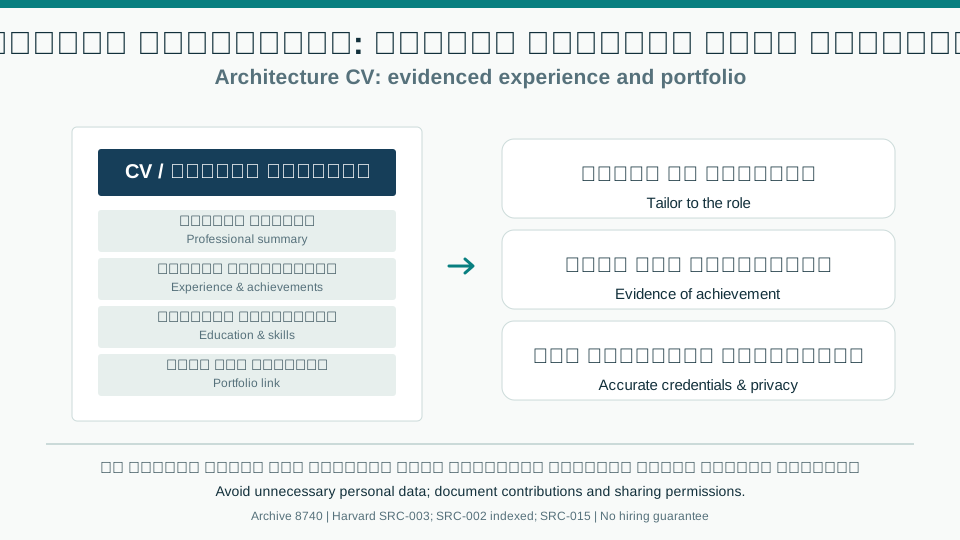
Use reverse chronological order, giving job titles, organizations, dates, responsibilities and verifiable achievements. An adaptable example: reviewed residential drawings and coordinated multidisciplinary comments, adding quantities or impact only if documented. Graduates may show studios, internships, competitions and relevant courses. List design and modeling tools and languages at honest proficiency levels, linking skills to deliverables where possible.
Portfolio and final review
In architecture, a portfolio may complement rather than replace the CV. Choose projects showing concept, method, actual contribution and outcomes, with authorization to share material and respect for confidentiality. Use clean formatting and readable text headings, saving in the format requested by the posting. Check dates, spelling, contact links and portfolio consistency; tailor keywords without stuffing or claiming skills you lack.
Comparison and verification table
| Factor | Evidence or action |
|---|---|
| Summary | Target role and specific professional value |
| Experience | Role, dates and substantiated contribution |
| Education and skills | Qualification, proficiency and evidence |
| Portfolio | Selected work, contribution and sharing rights |
A visual reading of the article topic
- 01Start with job requirements
- 02Evidence-based experience and projects
- 03Portfolio and final review
- 04Comparison and verification table
Practical workflow
- 01 Analyze job posting
- 02 Select relevant evidence
- 03 Align CV and portfolio
- 04 Check accuracy and privacy
Conceptual editorial diagram; not measured data.
Professional accreditation and practice boundaries
Engineering practice generally requires professional accreditation within the accredited discipline and grade, subject to the Article 2 provision for government engineering appointments, their assigned duties, and the competent regulators' power to require accreditation. Article 3 prohibits practice outside the accredited discipline and grade. State actual professional accreditation, discipline and grade accurately when relevant to the role, without claiming unearned credentials or permissions.
Topics and source excerpts
| Topic | Excerpt from article |
|---|---|
| Start with job requirements | The source covers assembling education, experience and skills in a CV. |
| Evidence-based experience and projects | Use reverse chronological order, giving job titles, organizations, dates, responsibilities and verifiable achievements. |
| Portfolio and final review | In architecture, a portfolio may complement rather than replace the CV. |
| Practical workflow | 01 Analyze job posting |
| Professional accreditation and practice boundaries | Engineering practice generally requires professional accreditation within the accredited discipline and grade, subject to the Article 2 provision for gover… |
| Sources and limitations | Editorial adaptation based on the original WordPress archive; original source retained separately. |
Source excerpts organized for comparison, not newly researched findings.
Sources and limitations
Editorial adaptation based on the original WordPress archive; original source retained separately. Historical personal-data recommendations were revised to limit unnecessary disclosure. Employer and legal requirements vary; formatting does not guarantee acceptance.
- Harvard: Create a Strong Resume — US-context career guidance supported by indexed text; not a Saudi rule on photos or personal information.
- Harvard: Create Impactful Resumes and Cover Letters — Tailoring, factual achievements, accuracy and reverse chronology; country norms vary.
- Engineering Professions Practice Law: Articles 2 and 3 — Professional accreditation, discipline and grade restrictions, subject to the Article 2 government appointment provision.