

An early-career experience
The author recounts a graduate taking on additional responsibility without clear improvement in pay or promised progression. Workplaces vary: verbal promises do not establish promotion, and delays do not mean accumulated experience has no value. Record responsibilities, deliverables and feedback against contractual scope, financial needs and personal circumstances.
Structured learning rather than accumulated hours
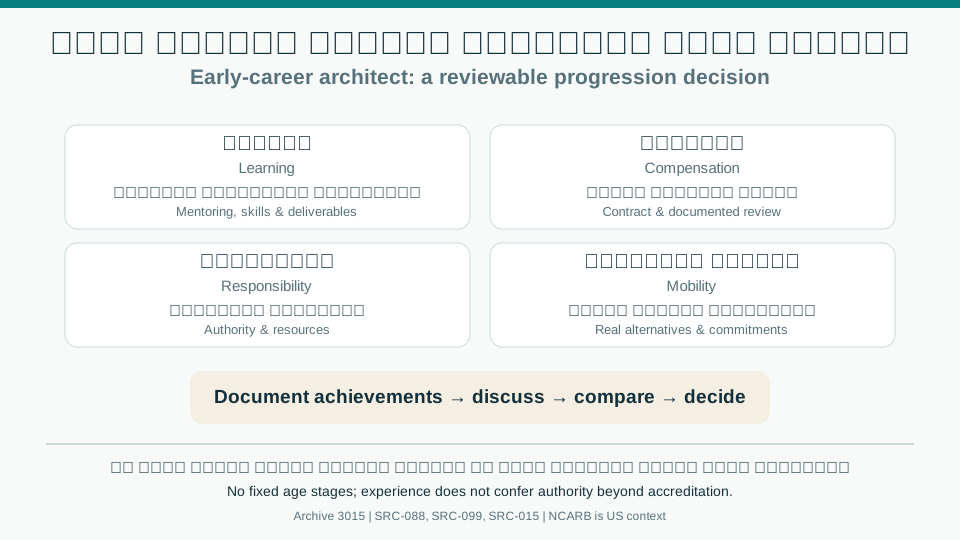
The source proposes broad early exploration followed by increasing selectivity. Small firms may offer varied tasks, while large organizations may offer specialized systems and complex projects, but neither pattern is universal. Compare mentoring, learning and project-stage exposure; do not accept unsafe or unlawful conditions simply to gain experience.
Stay or move
Request a professional discussion about objectives, performance criteria and a review timeline for role and compensation, documenting agreements. Assess real alternatives, market conditions and financial commitments before resignation. Develop design, communication, management, contract-scope and marketing skills while respecting confidentiality. Let decisions follow circumstances and evidence rather than age alone.
Decision review table
| Factor | Evidence or action |
|---|---|
| Learning | Mentoring, deliverables and new skills |
| Compensation | Contract and documented review |
| Responsibility | Authority, resources and accountability |
| Mobility | Alternatives, reserves and commitments |
A visual reading of the article topic
- 01An early-career experience
- 02Structured learning rather than accumulated hours
- 03Stay or move
- 04Decision review table
Practical workflow
- 01 Document achievements
- 02 Discuss progression
- 03 Compare learning and pay
- 04 Decide using evidence
Conceptual editorial diagram; not measured data.
Professional accreditation and practice boundaries
Engineering practice generally requires professional accreditation within the accredited discipline and grade, subject to the Article 2 provision for government engineering appointments, their assigned duties, and the competent regulators' power to require accreditation. Article 3 prohibits practice outside the accredited discipline and grade. Accumulated experience does not establish eligibility for practice beyond accreditation; employment contract terms and parties' rights require separate consideration.
Topics and source excerpts
| Topic | Excerpt from article |
|---|---|
| An early-career experience | The author recounts a graduate taking on additional responsibility without clear improvement in pay or promised progression. |
| Structured learning rather than accumulated hours | The source proposes broad early exploration followed by increasing selectivity. |
| Stay or move | Request a professional discussion about objectives, performance criteria and a review timeline for role and compensation, documenting agreements. |
| Practical workflow | 01 Document achievements |
| Professional accreditation and practice boundaries | Engineering practice generally requires professional accreditation within the accredited discipline and grade, subject to the Article 2 provision for gover… |
| Sources and limitations | Editorial adaptation based on the original WordPress archive; original source retained separately. |
Source excerpts organized for comparison, not newly researched findings.
Sources and limitations
Editorial adaptation based on the original WordPress archive; original source retained separately. The graduate case and earnings and revenue figures are historical testimony, unverified here; do not generalize to markets, nationalities or employers. Age stages are not fixed boundaries.
- Ministry of Human Resources and Social Development: Employment Relations — Articles 50–52 on employment contracts, remuneration, documentation and proof; not a determination of an individual dispute.
- NCARB: Experience Requirements — US architectural experience framework, not Saudi professional accreditation.
- Engineering Professions Practice Law: Articles 2 and 3 — Professional accreditation, discipline and grade restrictions, subject to the Article 2 government appointment provision.