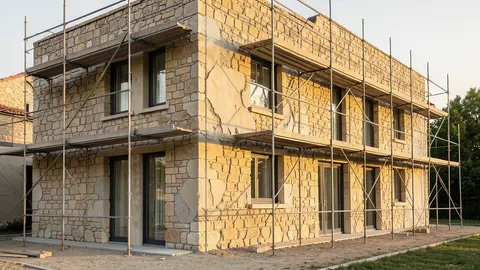
How does a building respond?
The article discusses ground motion and inertial forces during earthquakes. Building points do not all move identically; response depends on mass, stiffness, damping, system configuration, ground motion and soil. Shaking may cause forces, deformation and structural and nonstructural damage, while site conditions can add hazards such as ground instability. Perceived shaking alone does not establish building safety.
Design and risk-reduction principles
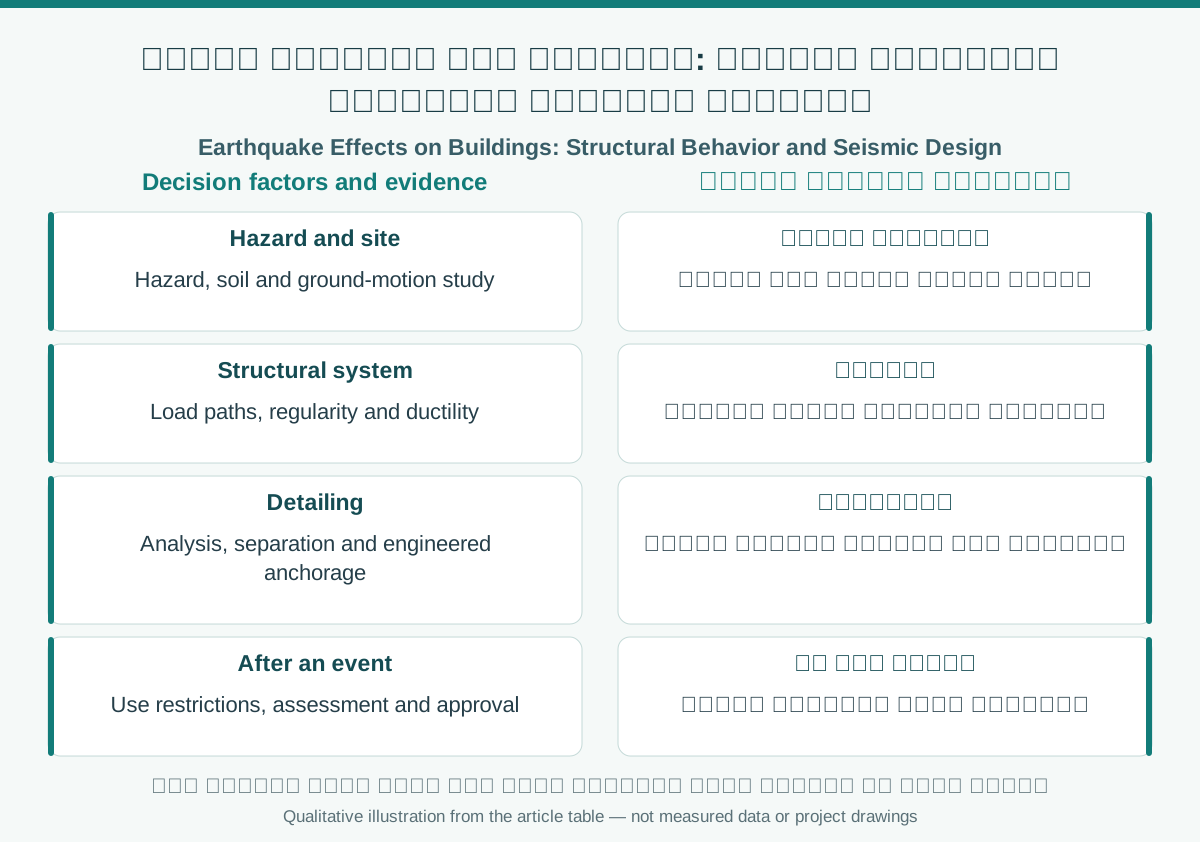
Regularity, mass and stiffness distribution, continuous load paths and ductile detailing can support seismic behavior when analysis verifies system suitability. Separation joints, base isolation and strengthening require project-specific motion, soil and detailing considerations. No universal building-length, slenderness or joint-size rule guarantees safety. Engineers establish applicable codes, local hazard and performance requirements, including nonstructural components and anchorage.
Post-earthquake assessment
Absence of collapse does not establish safe occupancy. After significant shaking follow authority instructions; stay clear of damaged areas with progressive cracking, leaning, falling components or visible damage, and do not re-enter an unsafe building before qualified assessment. Rehabilitation requires inspection, analysis, design and testing as appropriate, not improvised strengthening. The aim is risk reduction and specified performance, not a damage-proof building.
Decision review table
| Factor | Evidence or action |
|---|---|
| Hazard and site | Hazard, soil and ground-motion study |
| Structural system | Load paths, regularity and ductility |
| Detailing | Analysis, separation and engineered anchorage |
| After an event | Use restrictions, assessment and approval |
A visual reading of the article topic
- 01How does a building respond?
- 02Design and risk-reduction principles
- 03Post-earthquake assessment
- 04Decision review table
Practical workflow
- 01 Establish site hazard
- 02 Analyze system with qualified engineer
- 03 Verify detailing and construction
- 04 Assess safety after significant event
Conceptual editorial diagram; not measured data.
Sources and limitations
Editorial adaptation based on the original WordPress archive; original source retained separately. Numerical rules and structural details in the 2021 source are not universal design criteria. Verify applicable code and local hazard. This educational article neither certifies a building nor provides seismic design.
Topics and source excerpts
| Topic | Excerpt from article |
|---|---|
| How does a building respond? | The article discusses ground motion and inertial forces during earthquakes. |
| Design and risk-reduction principles | Regularity, mass and stiffness distribution, continuous load paths and ductile detailing can support seismic behavior when analysis verifies system suitabi… |
| Post-earthquake assessment | Absence of collapse does not establish safe occupancy. |
| Practical workflow | 01 Establish site hazard |
| Sources and limitations | Editorial adaptation based on the original WordPress archive; original source retained separately. |
| References and limitations | SBC 301 covers loads and seismic hazards, and SBC 304 includes seismic requirements for concrete structures. |
Source excerpts organized for comparison, not newly researched findings.
References and limitations
SBC 301 covers loads and seismic hazards, and SBC 304 includes seismic requirements for concrete structures. Verify applicable provisions and building-specific analysis; this article does not determine post-earthquake safety.
The following references support selected topics in the article.
- Saudi Code for Structural Design Loads, Seismic, and Wind SBC 301 (2024)
- Saudi Code for Concrete Structures SBC 304 (2024)
- ACI CODE-562-25 – Assessment, Repair, and Rehabilitation of Existing Concrete Structures