
A skills map rather than a certificate list
The source lists historical courses including The Architectural Imagination, Making Architecture, drawing, modeling, Revit, urban quality of life and portfolio preparation. Start with career stage and target tasks, then assess design fundamentals, programming, documentation, communication and digital coordination. Student, production architect and design manager priorities differ. A certificate alone does not demonstrate job capability.
Choose by learning outcome
Review syllabus, instructor, level, language, cost, time, assignments, assessment and update date. Theory should build interpretation of projects and context; drawing should develop scale and section clarity; digital modeling should produce exchangeable models and documents. Urban design courses can broaden understanding of buildings, streets and users. Do not assume historical courses or free access remain available; verify the official listing before enrollment.
Turn learning into professional evidence
Choose a small applied project integrating knowledge and outputs; retain drawings, models and decisions demonstrating your role, alternatives and response to feedback. Seek professional review and revise, then present work in a clear portfolio respecting project rights and client confidentiality. Evaluate training by repeatable improvement in quality or independence; use appropriate pathways for skills requiring supervised practice or professional accreditation.
Comparison and verification table
| Factor | Evidence or action |
|---|---|
| Theory and design | Project and program analysis |
| Drawing and documentation | Clear plans and sections |
| Digital modeling | Model and data exchange |
| Portfolio | Performance evidence and personal role |
A visual reading of the article topic
- 01A skills map rather than a certificate list
- 02Choose by learning outcome
- 03Turn learning into professional evidence
- 04Comparison and verification table
Practical workflow
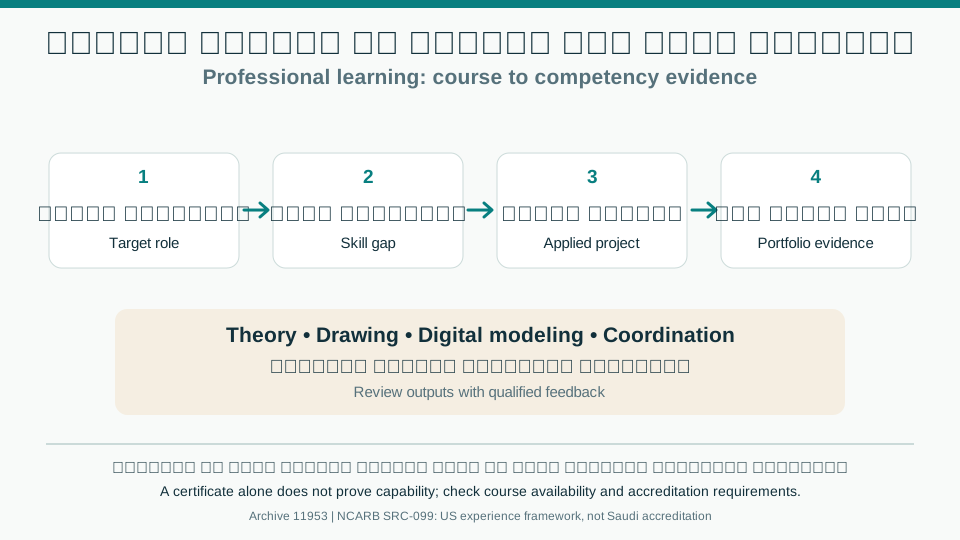
- 01 Define target role
- 02 Assess skill gap
- 03 Choose course and applied project
- 04 Review outputs and portfolio
Conceptual editorial diagram; not measured data.
Topics and source excerpts
| Topic | Excerpt from article |
|---|---|
| A skills map rather than a certificate list | The source lists historical courses including The Architectural Imagination, Making Architecture, drawing, modeling, Revit, urban quality of life and portf… |
| Choose by learning outcome | Review syllabus, instructor, level, language, cost, time, assignments, assessment and update date. |
| Turn learning into professional evidence | Choose a small applied project integrating knowledge and outputs; retain drawings, models and decisions demonstrating your role, alternatives and response… |
| Practical workflow | 01 Define target role |
| Sources and limitations | Editorial adaptation based on the original WordPress archive; original source retained separately. |
Source excerpts organized for comparison, not newly researched findings.
Sources and limitations
Editorial adaptation based on the original WordPress archive; original source retained separately. Historical course names, platforms, durations and prices are examples; current availability and enrollment terms require verification.
NCARB: Experience Requirements — US architectural experience and competency framework; not Saudi accreditation or course availability.