Testing is linked to project requirements
The article describes tests for fresh and hardened concrete. Tests vary with concrete type, function and project specifications. Ready-mixed concrete is batched and delivered for use, whereas precast concrete refers to elements manufactured before installation; the terms are not interchangeable. A quality plan defines the property, test method, sampling frequency and responsible inspector. One test cannot establish every material property.
Slump and flow in fresh concrete
Slump helps assess consistency for mixes suited to the method; it does not directly measure compressive strength. Flow methods differ by mix type, including tests for self-consolidating concrete. Do not interchange results from different methods. Qualified technicians review sampling time, temperature, procedures and apparatus against the specified method, reporting out-of-range results without unauthorized on-site mix adjustments.
Compressive strength and acceptance interpretation
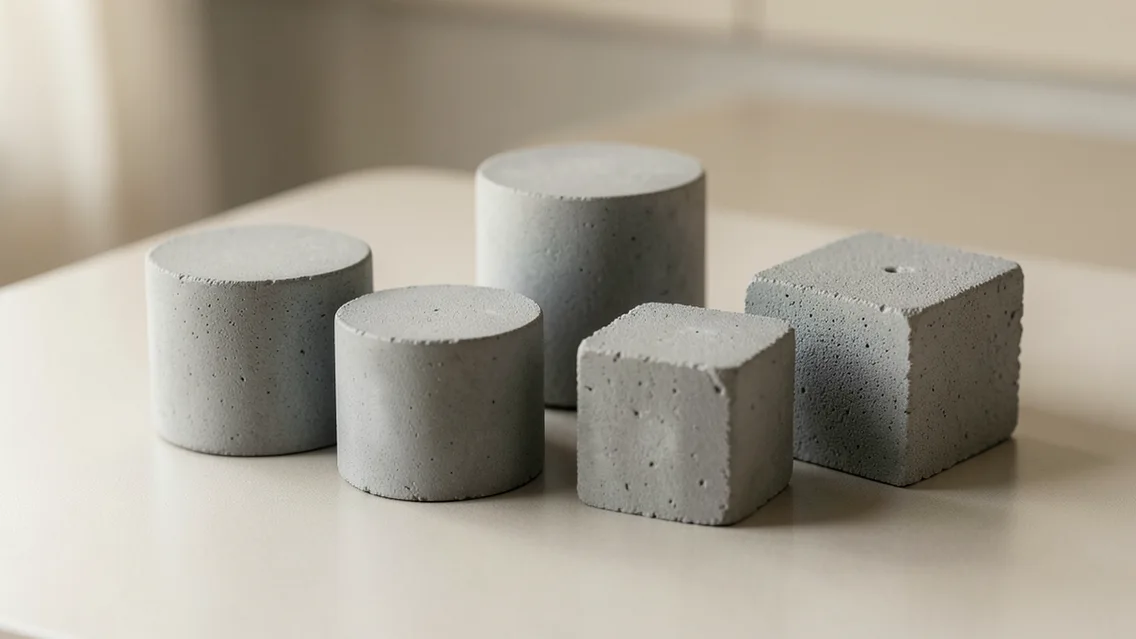
Strength results depend on specimen shape, dimensions, preparation, curing, age and loading rate. Do not compare cubes and cylinders using an unapproved universal conversion factor. Link laboratory results to the batch, element, casting date and curing conditions. For nonconforming results, engineers establish follow-up actions and tests under acceptance criteria. One low result does not prove failure, and one high result does not certify building safety.
Comparison and verification table
| Factor | Evidence or action |
|---|---|
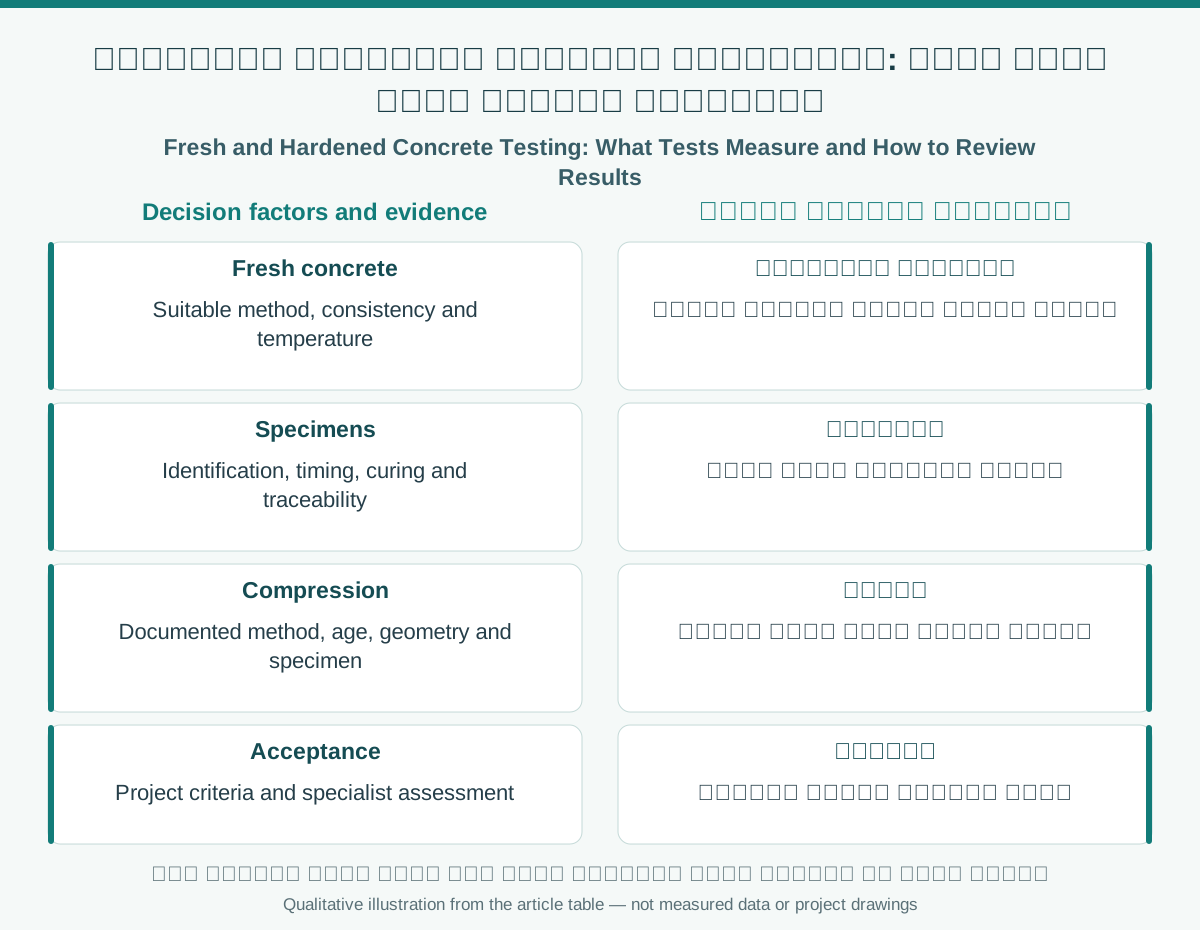
| Fresh concrete | Suitable method, consistency and temperature |
| Specimens | Identification, timing, curing and traceability |
| Compression | Documented method, age, geometry and specimen |
| Acceptance | Project criteria and specialist assessment |
A visual reading of the article topic
- 01Testing is linked to project requirements
- 02Slump and flow in fresh concrete
- 03Compressive strength and acceptance interpretation
- 04Comparison and verification table
Practical workflow
- 01 Define specification requirements
- 02 Approve sampling plan
- 03 Use qualified testing personnel
- 04 Review results and approved actions
Conceptual editorial diagram; not measured data.
Sources and limitations
Editorial adaptation based on the original WordPress archive; original source retained separately. Historical dimensions, timings, consolidation and curing procedures require reconciliation with the specified standard and edition. This is not a test protocol or structural acceptance decision.
Topics and source excerpts
| Topic | Excerpt from article |
|---|---|
| Testing is linked to project requirements | The article describes tests for fresh and hardened concrete. |
| Slump and flow in fresh concrete | Slump helps assess consistency for mixes suited to the method; it does not directly measure compressive strength. |
| Compressive strength and acceptance interpretation | Strength results depend on specimen shape, dimensions, preparation, curing, age and loading rate. |
| Practical workflow | 01 Define specification requirements |
| Sources and limitations | Editorial adaptation based on the original WordPress archive; original source retained separately. |
| References and limitations | Slump is a method-limited indicator, not a direct compressive-strength measurement. |
Source excerpts organized for comparison, not newly researched findings.
References and limitations
Slump is a method-limited indicator, not a direct compressive-strength measurement. Strength interpretation depends on specimens, preparation, testing and applicable acceptance criteria, as reflected in ACI references.
The following references support selected topics in the article.
- ACI FAQ – Why is the slump test not an absolute measure of consistency or workability?
- ACI FAQ – How is the required strength selected, measured, and obtained?
- ACI FAQ – Size of test cylinder
- Saudi Code for Concrete Structures SBC 304 (2024)