
Diagnose the position and define audiences
The source proposes analyzing strengths, weaknesses, opportunities and threats before setting goals. Study client segments, projects, needs and provider-selection processes, defining services the practice can competently and lawfully deliver. Distinguish founders’ past experience from the firm's own projects; do not attribute projects to a new practice without stating its actual role. Articulate the problem solved and evidence of capability.
Channels, content and budget
Websites, portfolios, social platforms, exhibitions, referrals and educational content can serve different roles. Link each channel to its audience and purpose rather than applying a contractor's strategy unchanged to a design practice or training center. Publish authorized case studies showing scope, outcome and actual contribution. Protect client privacy and avoid fabricated testimonials or undisclosed incentives. Allocate budgets according to resources and follow-up capacity.
Measure conversion and review
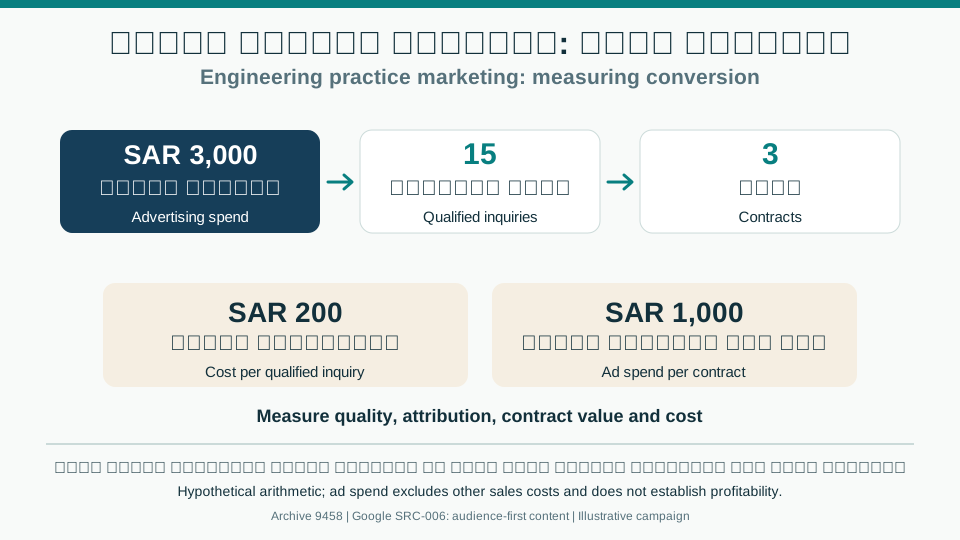
Set time-bounded measurable goals, such as qualified inquiries, meetings, proposals and contracts. Hypothetically, SAR 3,000 spent on a campaign producing 15 qualified inquiries means SAR 200 per inquiry; three contracts imply SAR 1,000 advertising cost per contract, excluding staff and sales costs. Views are not revenue, and customer counts do not establish profitability. Review lead quality, contract value, costs and attribution before scaling.
Comparison and verification table
| Factor | Evidence or action |
|---|---|
| Audience | Need, segment and buying decision |
| Value | Defined service and substantiated work |
| Channels | Role, budget and content |
| Conversion | Qualified inquiry, proposal, contract and cost |
A visual reading of the article topic
- 01Diagnose the position and define audiences
- 02Channels, content and budget
- 03Measure conversion and review
- 04Comparison and verification table
Practical workflow
- 01 Assess position and market
- 02 Define goals and audiences
- 03 Run a bounded campaign
- 04 Review conversion, cost and quality
Conceptual editorial diagram; not measured data.
Topics and source excerpts
| Topic | Excerpt from article |
|---|---|
| Diagnose the position and define audiences | The source proposes analyzing strengths, weaknesses, opportunities and threats before setting goals. |
| Channels, content and budget | Websites, portfolios, social platforms, exhibitions, referrals and educational content can serve different roles. |
| Measure conversion and review | Set time-bounded measurable goals, such as qualified inquiries, meetings, proposals and contracts. |
| Practical workflow | 01 Assess position and market |
| Sources and limitations | Editorial adaptation based on the original WordPress archive; original source retained separately. |
Source excerpts organized for comparison, not newly researched findings.
Sources and limitations
Editorial adaptation based on the original WordPress archive; original source retained separately. 2021 platform and tactic examples are historical and require current feature checks. Figures are hypothetical, not campaign results.
Google: Helpful, people-first content — Usefulness, expertise and audience needs; no ranking or conversion guarantee.