
Start with audience needs
The source discusses architectural content sponsorship and marketing as a way to establish a specialized presence among customers, engineers and investors. Homeowners making building decisions, engineers reviewing a system and developers assessing feasibility have different questions. Identify audiences and their decision stages, then choose topics answering genuine questions with verifiable information. Attractive images and generic material alone may not support meaningful decisions.
Content production, distribution and integrity
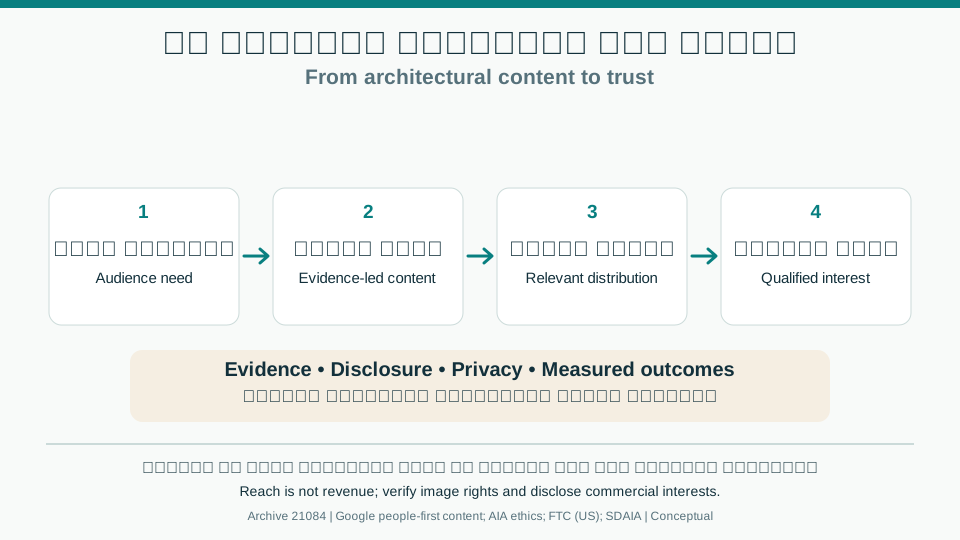
Use educational articles, material comparisons, drawing critiques, case studies and diagrams with documented sources, dates and assumptions. A website can anchor long-form material, while short posts and videos adapt ideas without dropping important caveats. Disclose sponsorship or commercial interests clearly, separate editorial judgment from product claims and check image rights and client confidentiality. Do not fabricate statistics or promises to improve reach or engagement.
From reach to qualified interest
Connect content to a suitable next step such as reading a reference or requesting consultation through a clear channel without forcing every reader to buy. Measure visits, reading, qualified inquiries, communication quality and documented conversions, distinguishing engagement from commercial opportunities and revenue. Compare topics and formats over defined test periods and improve what demonstrates value. Protect data privacy and attribution accuracy; views alone do not establish brand success.
Comparison and verification table
| Factor | Evidence or action |
|---|---|
| Audience | Need, question and decision stage |
| Content | Evidence, source and suitable format |
| Trust | Disclosure, rights and integrity |
| Outcome | Qualified inquiry and documented conversion |
A visual reading of the article topic
- 01Start with audience needs
- 02Content production, distribution and integrity
- 03From reach to qualified interest
- 04Comparison and verification table
Practical workflow
- 01 Define audience and question
- 02 Produce evidence-based content
- 03 Distribute by channel role
- 04 Measure outcomes and refine
Conceptual editorial diagram; not measured data.
Direct marketing and personal data safeguards
When processing personal data for direct marketing in Saudi Arabia, obtain freely given, purpose-specific and documented consent, identify the sender, provide an easy opt-out and stop sending marketing material without undue delay after consent is withdrawn, subject to other applicable laws. Campaign procedures and activity-specific requirements still need separate review.
Topics and source excerpts
| Topic | Excerpt from article |
|---|---|
| Start with audience needs | The source discusses architectural content sponsorship and marketing as a way to establish a specialized presence among customers, engineers and investors. |
| Content production, distribution and integrity | Use educational articles, material comparisons, drawing critiques, case studies and diagrams with documented sources, dates and assumptions. |
| From reach to qualified interest | Connect content to a suitable next step such as reading a reference or requesting consultation through a clear channel without forcing every reader to buy. |
| Practical workflow | 01 Define audience and question |
| Direct marketing and personal data safeguards | When processing personal data for direct marketing in Saudi Arabia, obtain freely given, purpose-specific and documented consent, identify the sender, prov… |
| Sources and limitations | Editorial adaptation based on the original WordPress archive; original source retained separately. |
Source excerpts organized for comparison, not newly researched findings.
Sources and limitations
Editorial adaptation based on the original WordPress archive; original source retained separately. Claims about content or sponsorship effects on sales require independent data; this is an editorial framework, not a sales promise or approved strategy for a particular brand.
- Google: helpful, people-first content — Audience relevance and usefulness, without ranking guarantees.
- AIA: Code of Ethics and Professional Conduct — Truthful claims, confidentiality and attribution; guidance for AIA members, not Saudi law.
- US FTC: Disclosures 101 for Social Media Influencers — Commercial relationship disclosure in the US context, not Saudi licensing.
- SDAIA: Implementing Regulation of the Personal Data Protection Law, Articles 11 and 29 — Consent, withdrawal and sender identity in direct marketing.