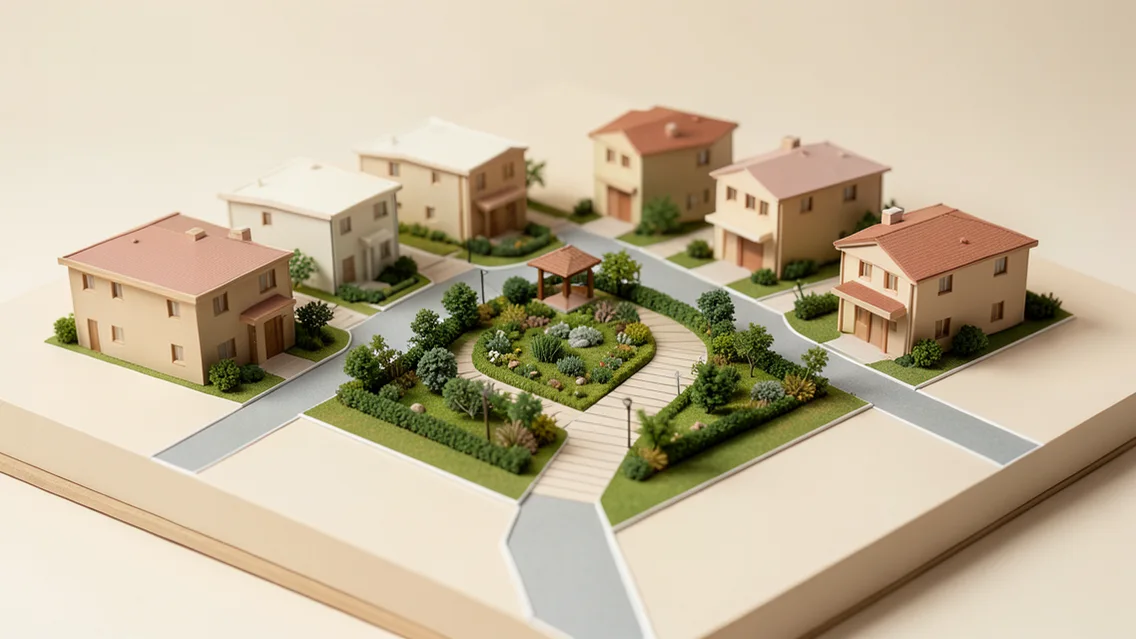
Location within a movement network
A map point or straight-line distance cannot describe daily experience. Roads, walking, transport, congestion, safety and barriers determine access. Geometrically similar properties may have different accessibility.
Service catchments
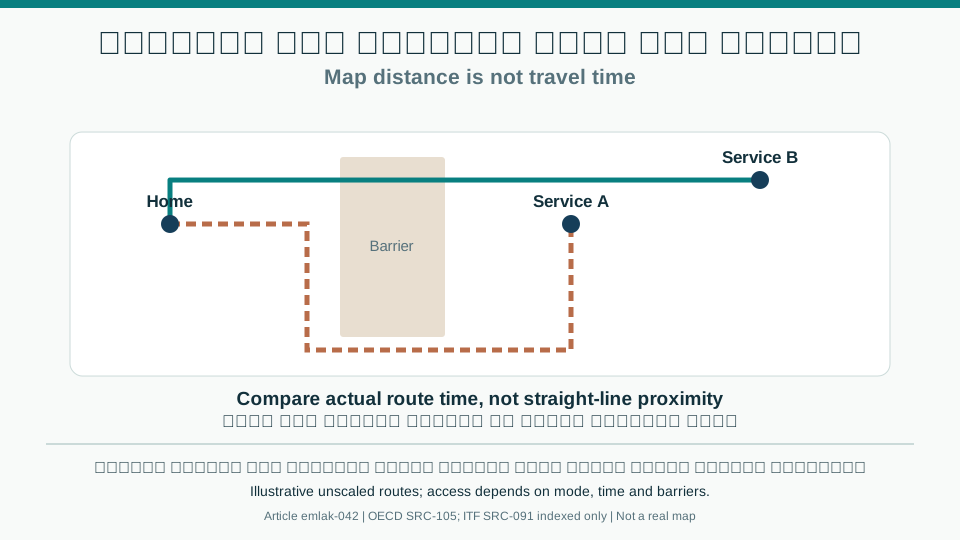
Travel-time maps can show five-, ten- or fifteen-minute catchments for a specified mode and period. The fifteen-minute city is a planning concept, not a pricing rule. Distinguish existing from planned services.
Analysing daily trips
Compare access to work, education, healthcare, shopping and public spaces. Hypothetically, four kilometres on a direct route may be faster than two kilometres with barriers or congestion. These are illustrative distances, not site measurements.
Identify services
Measure time
Compare alternatives
Test value effect
From access to value
Isolating the price effect of access requires comparable transactions controlling for quality, age, area and timing. Do not convert minutes saved into a monetary premium without evidence. Combine network analysis and traffic mapping with inspection.
A visual reading of the article topic
- 01Location within a movement network
- 02Service catchments
- 03Analysing daily trips
- 04From access to value
Decision review table
| Factor | Evidence to check |
|---|---|
| Service | Type and operating status |
| Mode | Walking, driving or transit |
| Time | Period and actual trip |
| Value | Transactions and other factors |
Practical workflow
- Identify services
- Measure time
- Compare alternatives
- Test value effect
Topics and source excerpts
| Topic | Excerpt from article |
|---|---|
| Location within a movement network | A map point or straight-line distance cannot describe daily experience. |
| Service catchments | Travel-time maps can show five-, ten- or fifteen-minute catchments for a specified mode and period. |
| Analysing daily trips | Compare access to work, education, healthcare, shopping and public spaces. |
| From access to value | Isolating the price effect of access requires comparable transactions controlling for quality, age, area and timing. |
| Practical workflow | Identify services |
| Source and limitations | Editorial expansion of the author's Emlak contribution; the historical text is retained. |
Source excerpts organized for comparison, not newly researched findings.
Source and limitations
Editorial expansion of the author's Emlak contribution; the historical text is retained. Insufficient documentation was recovered for the named index or any universal price uplift.
- ITF: What is the Urban Access Framework? — Indexed text distinguishing time-and-mode accessibility from distance-based proximity; European study, not Saudi price premiums or outcomes.
- OECD: Benchmarking Accessibility in Cities — Readable abstract supports the distinction between accessibility and proximity across travel modes; not local outcomes or causal price effects.