
The problem the technology addresses
The source discusses entry costs, transaction delays and illiquidity in property investment. Distributed ledgers may help multiple parties trace transaction events under defined permissions and rules. Digital tokens may represent interests in a property-owning entity or other contractual rights. Technology alone does not establish the nature of those rights; identify what a token represents and who is legally bound by it.
Tokenization, contracts and title
Smaller investment units, transfer records and programmed distribution rules may be possible. Buying a token does not necessarily convey registered ownership of part of a property, and smart contracts cannot replace title registration, legal diligence or obligations outside the ledger. Valuation, financing, identity checks and dispute processes may remain necessary. Technical transferability does not guarantee a buyer or active secondary market.
Due diligence before investing
Review entity structure, investor rights, claim priority, fees, distributions, exit restrictions and key and data custody. Risks include software errors, inaccurate original inputs, operator failure, lost access and regulatory changes. Establish the applicable authorities and rules for the asset, instrument and investor jurisdiction before committing. Compare digital and conventional alternatives on risks, costs and potential returns without assuming technical transparency reduces all risks.
Comparison and verification table
| Factor | Evidence or action |
|---|---|
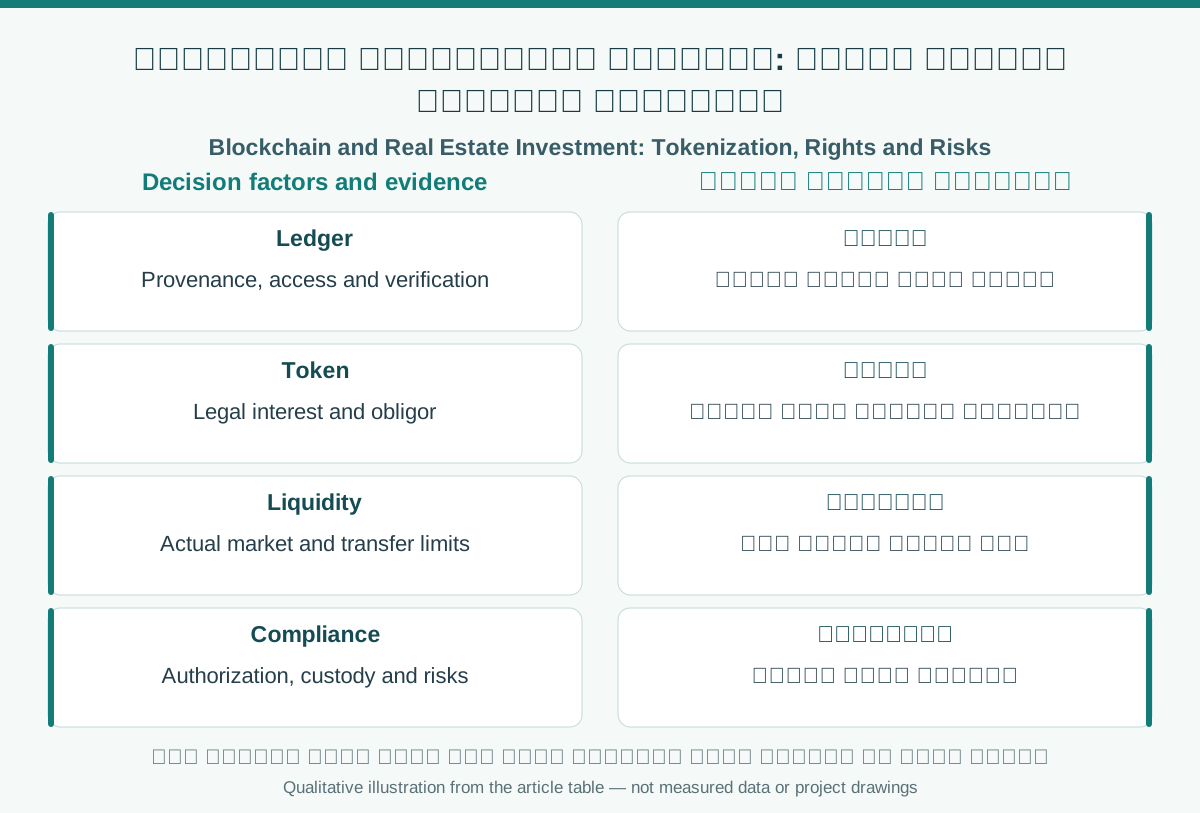
| Ledger | Provenance, access and verification |
| Token | Legal interest and obligor |
| Liquidity | Actual market and transfer limits |
| Compliance | Authorization, custody and risks |
A visual reading of the article topic
- 01The problem the technology addresses
- 02Tokenization, contracts and title
- 03Due diligence before investing
- 04Comparison and verification table
Practical workflow
- 01 Identify the represented right
- 02 Review asset and entity
- 03 Check regulation and exit
- 04 Compare risks before deciding
Conceptual editorial diagram; not measured data.
Sources and limitations
Editorial adaptation based on the original WordPress archive; original source retained separately. Historical promises of universal access, liquidity or shorter transactions are not guaranteed; rights and activities require current legal and financial verification.
Topics and source excerpts
| Topic | Excerpt from article |
|---|---|
| The problem the technology addresses | The source discusses entry costs, transaction delays and illiquidity in property investment. |
| Tokenization, contracts and title | Smaller investment units, transfer records and programmed distribution rules may be possible. |
| Due diligence before investing | Review entity structure, investor rights, claim priority, fees, distributions, exit restrictions and key and data custody. |
| Practical workflow | 01 Identify the represented right |
| Sources and limitations | Editorial adaptation based on the original WordPress archive; original source retained separately. |
| References and limitations | REGA announced the first title-deed tokenization on 19 November 2025 under regulatory oversight. |
Source excerpts organized for comparison, not newly researched findings.
References and limitations
REGA announced the first title-deed tokenization on 19 November 2025 under regulatory oversight. This does not establish that every token confers registered real rights or guaranteed liquidity. Verify the instrument, authorization, registration and exit conditions.
The following references support selected topics in the article.
- SPA — REGA announcement of first real estate tokenization, 19 Nov 2025
- REGA — Regulatory Framework for Experimental Regulatory Environment
- REGA — Law of Real Estate Registration, arts 7–8