
Why adoption matters
The historical article asks whether practices are ready for digital transformation, noting unequal resources across firm sizes. AI's value is not limited to image generation: it can assist requirements organization, preliminary research, option comparison, document editing and repetitive work. Benefits depend on data quality, task and verifiability; acquiring tools alone does not transform practice.
How a small practice can start
Select a measurable recurring task such as sorting project requirements. Record time and errors before and after a pilot and compare representative cases. Integrate tools gradually with organized project files while defining reviewers, versions and sources. Protect client information and review data-use terms and licenses before uploading files to external services. Do not automate sensitive design decisions simply because a model can suggest an answer quickly.
Human and professional responsibility
Automation may change task allocation and required skills, but neither universal job loss nor unchanged employment can be guaranteed. Qualified professionals must check dimensions, assumptions, references and compliance; generated output is not a safety certificate or approval. Architects guide decisions through user experience, culture, climate and cost, retaining decision records. Measure adoption by verifiable outcomes and work quality rather than staff reduction alone.
Comparison and verification table
| Factor | Evidence or action |
|---|---|
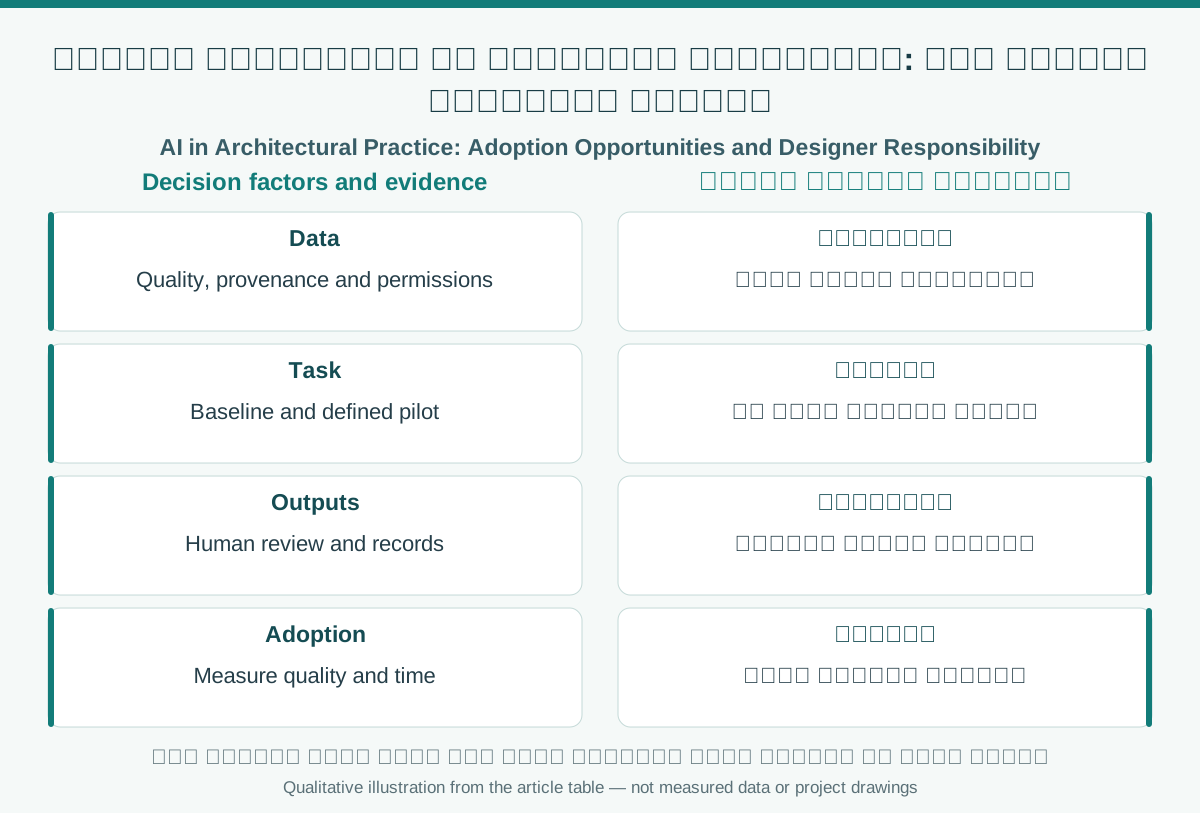
| Data | Quality, provenance and permissions |
| Task | Baseline and defined pilot |
| Outputs | Human review and records |
| Adoption | Measure quality and time |
A visual reading of the article topic
- 01Why adoption matters
- 02How a small practice can start
- 03Human and professional responsibility
- 04Comparison and verification table
Practical workflow
- 01 Select a measurable task
- 02 Review data and privacy
- 03 Pilot and compare
- 04 Scale verified benefits
Conceptual editorial diagram; not measured data.
Sources and limitations
Editorial adaptation based on the original WordPress archive; original source retained separately. Historical predictions about employment and adoption rates require updated evidence and are not presented as verified current facts.
Topics and source excerpts
| Topic | Excerpt from article |
|---|---|
| Why adoption matters | The historical article asks whether practices are ready for digital transformation, noting unequal resources across firm sizes. |
| How a small practice can start | Select a measurable recurring task such as sorting project requirements. |
| Human and professional responsibility | Automation may change task allocation and required skills, but neither universal job loss nor unchanged employment can be guaranteed. |
| Practical workflow | 01 Select a measurable task |
| Sources and limitations | Editorial adaptation based on the original WordPress archive; original source retained separately. |
| References and limitations | Define AI use, risks and review responsibilities and measure performance before adoption. |
Source excerpts organized for comparison, not newly researched findings.
References and limitations
Define AI use, risks and review responsibilities and measure performance before adoption. NIST guidance is voluntary; generated output is not professional approval or code verification.
The following references support selected topics in the article.
- NIST AI RMF
- NIST AI RMF Playbook
- buildingSMART — Information Delivery Specification