Establish need and existing capacity
The article discusses strengthening due to design or construction shortcomings, deterioration, changing loads or added stories. Specialists review documentation, current and proposed loads, load paths and foundations, investigate conditions and perform appropriate testing. One nondestructive test cannot establish member strength or building capacity. If instability or severe damage is suspected, restrict affected areas and have engineers determine necessary measures rather than improvising alterations.
Compare strengthening systems
Concrete jackets may increase section size or modify performance; steel solutions or fiber-reinforced polymer (FRP) systems can suit specifically engineered cases. Review load transfer, connections, bond, compatibility, deformation, fire, moisture and corrosion, plus effects on adjacent members and foundations. Steel structures also require member and connection stability and buckling checks. Material labels or additional reinforcement alone do not establish suitability.
Safe execution and verification
Altering load-bearing elements requires approved design, temporary works and sequencing accounting for load transfer, stability and removal risks. Do not break cover, cut or install reinforcement, or remove supports based on generic article steps. Qualified teams establish construction details, inspections and loading authorization under calculations and specifications. Record results, changes, acceptance checks and monitoring; finished appearance is not occupancy approval.
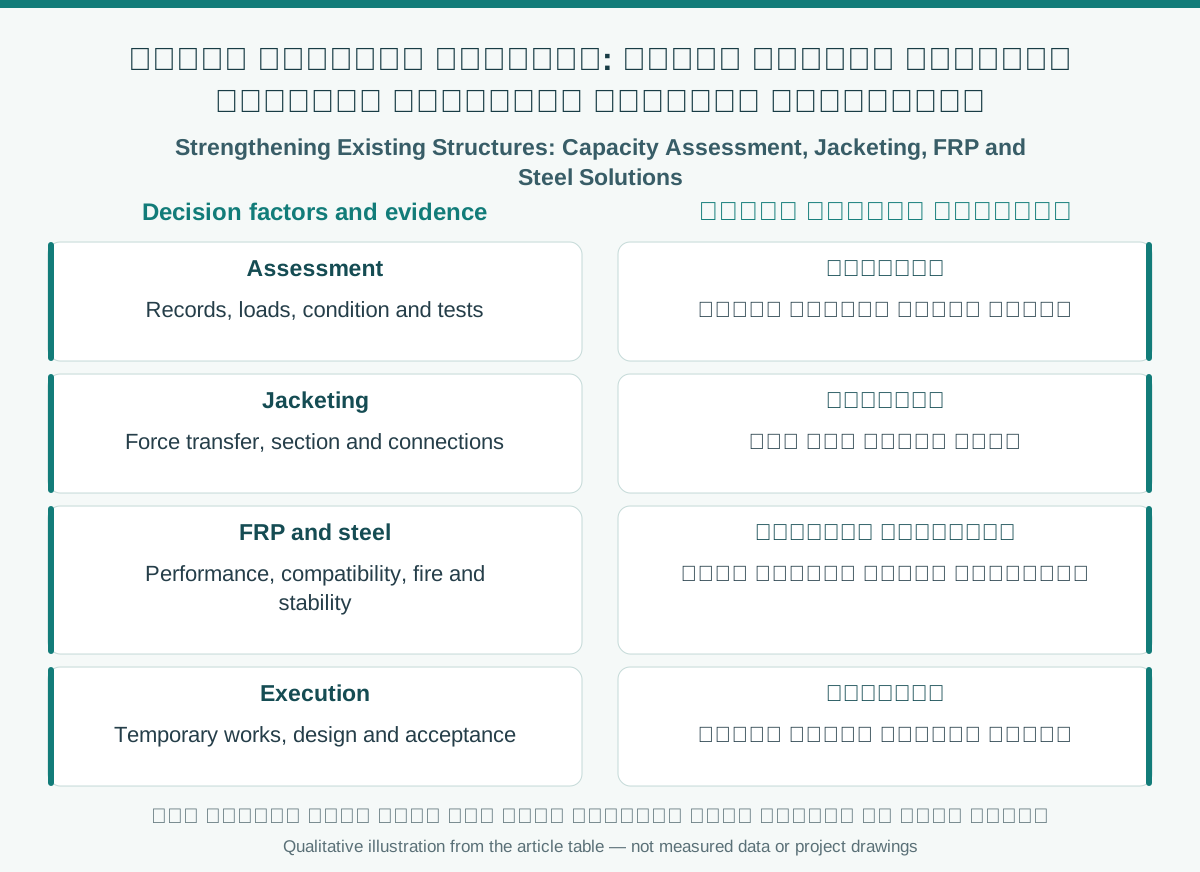
Comparison and verification table
| Factor | Evidence or action |
|---|---|
| Assessment | Records, loads, condition and tests |
| Jacketing | Force transfer, section and connections |
| FRP and steel | Performance, compatibility, fire and stability |
| Execution | Temporary works, design and acceptance |
A visual reading of the article topic
- 01Establish need and existing capacity
- 02Compare strengthening systems
- 03Safe execution and verification
- 04Comparison and verification table
Practical workflow
- 01 Identify strengthening driver
- 02 Assess capacity and complete system
- 03 Compare options and approve design
- 04 Verify delivery and occupancy authorization
Conceptual editorial diagram; not measured data.
Sources and limitations
Editorial adaptation based on the original WordPress archive; original source retained separately. Historical removal, anchoring, propping and strengthening sequences are not adopted as construction instructions. No calculations, reinforcement details or loading authorization are provided; qualified engineering is required.
Topics and source excerpts
| Topic | Excerpt from article |
|---|---|
| Establish need and existing capacity | The article discusses strengthening due to design or construction shortcomings, deterioration, changing loads or added stories. |
| Compare strengthening systems | Concrete jackets may increase section size or modify performance; steel solutions or fiber-reinforced polymer (FRP) systems can suit specifically engineere… |
| Safe execution and verification | Altering load-bearing elements requires approved design, temporary works and sequencing accounting for load transfer, stability and removal risks. |
| Practical workflow | 01 Identify strengthening driver |
| Sources and limitations | Editorial adaptation based on the original WordPress archive; original source retained separately. |
| References and limitations | ACI 562-25 covers existing-structure assessment, strengthening and repair. |
Source excerpts organized for comparison, not newly researched findings.
References and limitations
ACI 562-25 covers existing-structure assessment, strengthening and repair. Do not select jackets, fibers or steel before evaluating capacity and designing load transfer and temporary works.
The following references support selected topics in the article.
- ACI CODE-562-25 – Assessment, Repair, and Rehabilitation of Existing Concrete Structures
- ACI FAQ – What steps are taken in the repair of concrete structures?
- OSHA 1926.703 – Requirements for cast-in-place concrete