
What the legal interest represents
The original concept divides an asset investment into smaller fractions. A fraction may be direct co-ownership, an interest in an entity owning property, or a contractual claim linked to income; rights and obligations differ. Calling a digital token a property representation does not establish registered title or an enforceable legal right.
Technology, transparency and liquidity
A digital platform may help record transactions, display distributions and track rights, but technical record integrity does not guarantee underlying documentation, custody or asset quality. Verify the operator, authorization, independent custody, contracts and dispute resolution. A secondary market does not guarantee a buyer or a fair exit price.
An illustration of fractionalization
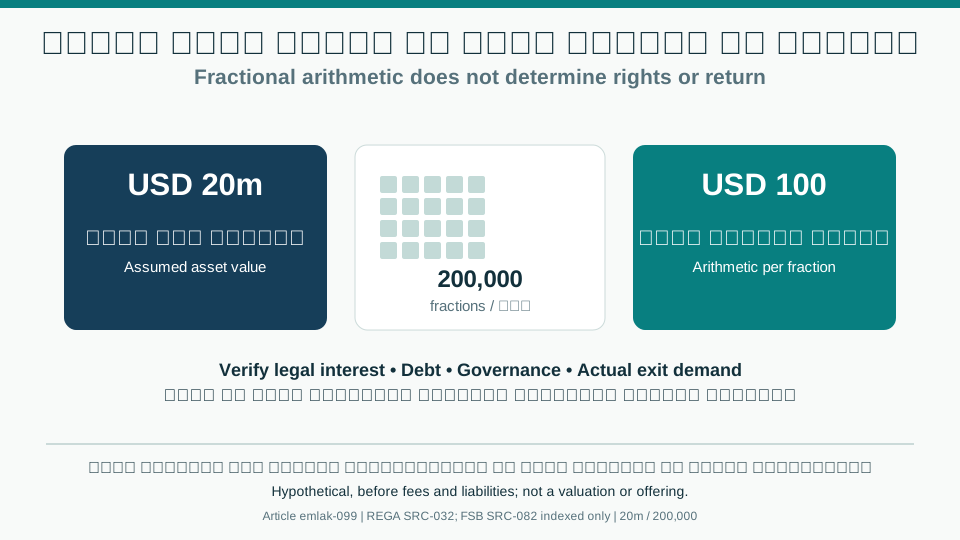
The original uses a hypothetical USD 20 million property divided into 200,000 fractions, arithmetically USD 100 each before fees and liabilities. This division does not establish investment value, voting rights, creditor priority or net distributions. Review valuation, debt, expenses, governance and exit conditions before deciding.
Decision review table
| Factor | Evidence or action |
|---|---|
| Legal interest | Title, entity interest or claim |
| Operation | Authorization, custody and reporting |
| Income | Distributions after debt and expenses |
| Exit | Transferability and actual market demand |
A visual reading of the article topic
- 01What the legal interest represents
- 02Technology, transparency and liquidity
- 03An illustration of fractionalization
- 04Decision review table
Practical workflow
- 01 Understand legal interest
- 02 Verify operator and asset
- 03 Review net cash flows
- 04 Test exit and risk
Conceptual editorial diagram; not measured data.
Topics and source excerpts
| Topic | Excerpt from article |
|---|---|
| What the legal interest represents | The original concept divides an asset investment into smaller fractions. |
| Technology, transparency and liquidity | A digital platform may help record transactions, display distributions and track rights, but technical record integrity does not guarantee underlying docum… |
| An illustration of fractionalization | The original uses a hypothetical USD 20 million property divided into 200,000 fractions, arithmetically USD 100 each before fees and liabilities. |
| Practical workflow | 01 Understand legal interest |
| Sources and limitations | Editorial development based on the author’s original Emlak article; previous text retained. |
Source excerpts organized for comparison, not newly researched findings.
Sources and limitations
Editorial development based on the author’s original Emlak article; previous text retained. The example is hypothetical arithmetic. Tokenization or fractional ownership is not assumed authorized in every form or available to every person; verify applicable rules and authorities before legal details or any offer.
- FSB: The Financial Stability Implications of Tokenisation, October 2024 — Indexed official summary on liquidity and maturity mismatch, leverage, asset quality and operational fragilities; not Saudi authorization or individual investor rights.
- REGA: Law of Real Estate Registration — Articles 8 and 10–14 on initial registration, evidentiary force, challenges and subsequent rights; not proof of individual eligibility or registered title through a token.