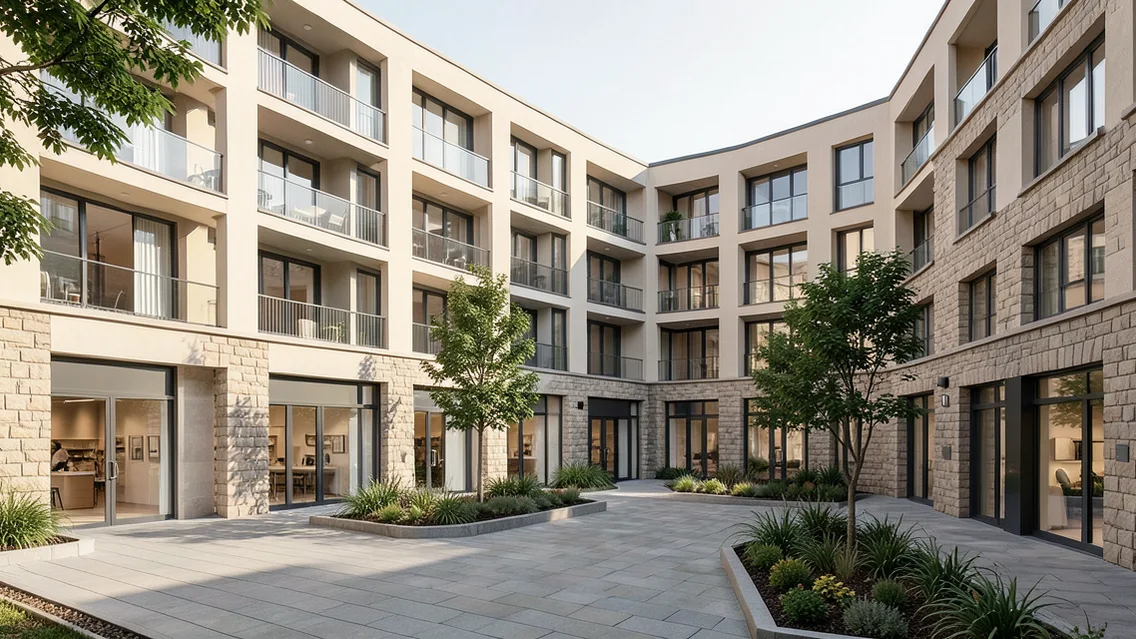
Integration beyond adjacency
The source explores mixed uses as a route to vibrant districts. Integration requires services matching residents, workers and visitors and safe, comfortable connections. Retail below housing does not guarantee integration when circulation, noise and privacy conflict.
Circulation and infrastructure
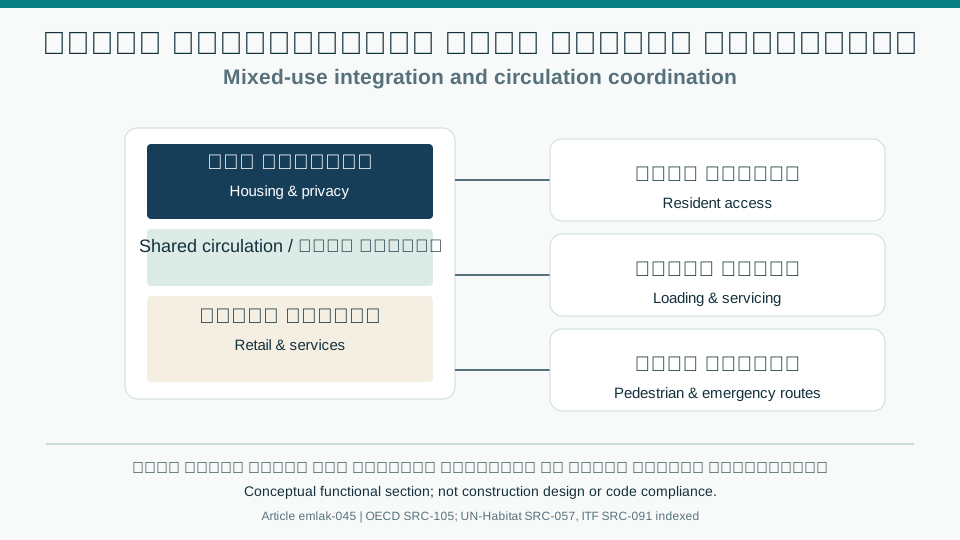
Coordinate pedestrian, vehicle, loading and emergency routes, separating service and residential access where needed. Assess utilities at peak demand, shaded routes, accessibility and public-space operating costs. Verify project-specific classifications and requirements.
Economics and phased delivery
Mixed uses may diversify income while sharing location, customer and finance risks. Calculate revenues and costs by use, allocate shared expenses and stress-test delayed leasing of a component. Begin with demonstrated demand and tie expansion to occupancy, actual use and maintenance evidence.
Decision review table
| Factor | Evidence to check |
|---|---|
| Housing | Privacy and comfort |
| Commerce | Access, loading and demand |
| Public realm | Movement, shade, maintenance |
| Management | Cost and responsibility allocation |
A visual reading of the article topic
- 01Integration beyond adjacency
- 02Circulation and infrastructure
- 03Economics and phased delivery
- 04Decision review table
Practical workflow
- Analyze users
- Coordinate uses
- Test feasibility
- Monitor operations
References and limitations
Topics and source excerpts
| Topic | Excerpt from article |
|---|---|
| Integration beyond adjacency | The source explores mixed uses as a route to vibrant districts. |
| Circulation and infrastructure | Coordinate pedestrian, vehicle, loading and emergency routes, separating service and residential access where needed. |
| Economics and phased delivery | Mixed uses may diversify income while sharing location, customer and finance risks. |
| References and limitations | Editorial expansion of the author's Emlak contribution; the previous text is retained. |
Source excerpts organized for comparison, not newly researched findings.
Editorial expansion of the author's Emlak contribution; the previous text is retained. Public-space guidance is methodological, not local regulation or a return guarantee.
- UN-Habitat: Five Principles of Neighbourhood Design — Indexed official 2014 summary on connected, integrated, mixed-use neighborhoods; not Saudi requirements, local outcomes or adopted numerical densities.
- ITF: What is the Urban Access Framework? — Indexed text distinguishing time-and-mode accessibility from distance-based proximity; European study, not Saudi price premiums or outcomes.
- OECD: Benchmarking Accessibility in Cities — Readable abstract supports the distinction between accessibility and proximity across travel modes; not local outcomes or causal price effects.