
Principle of prestressing
The article explains introducing calculated compressive effects in concrete through high-strength tendons to modify load-induced stresses. This may limit tensile stress and deflection in specific cases but does not guarantee the absence of cracking or corrosion. Behavior depends on tendon location and forces, section geometry, loads, prestress losses and time-dependent concrete properties. Engineers establish strength and serviceability criteria under the system and applicable code.
Pretensioning and post-tensioning
In pretensioning, tendons are stressed before concrete placement and forces transferred after specified concrete strength is achieved under the system. In post-tensioning, tendons are stressed after concrete hardens and meets approved stressing criteria; tendons may be bonded or unbonded. Anchorage, protection, tests and sequencing differ. These are high-stored-energy operations: stressing, cutting tendons or drilling a potentially post-tensioned member requires approved procedures and qualified assessment.
Coordination and lifetime value
Some solutions may permit longer spans, thinner slabs or lower dead loads, but compare alternatives for shear, punching, deflection, fire, vibration, detailing, construction and maintenance. Coordinate tendon routes, openings and services early, retaining as-built records and inspection results. Do not reduce reinforcement or thickness, or modify openings, without approved structural verification.
Comparison and verification table
| Factor | Evidence or action |
|---|---|
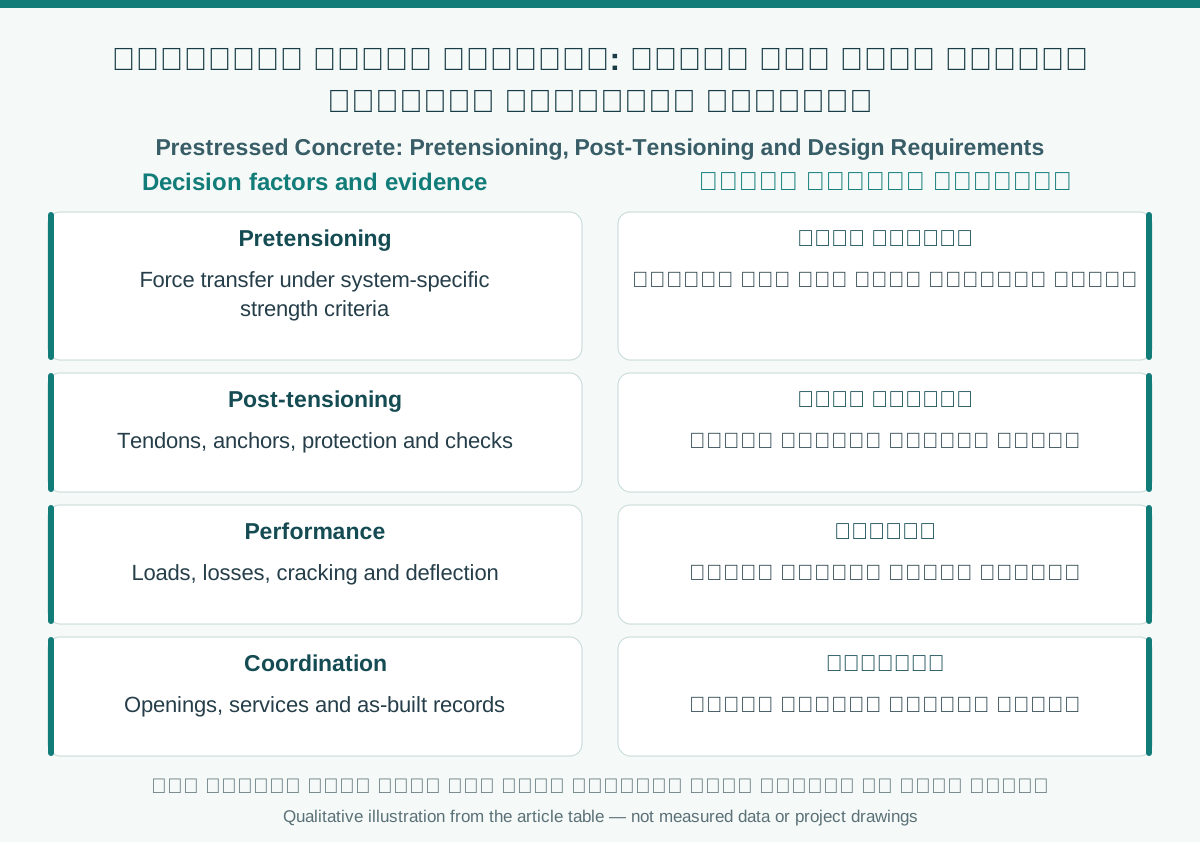
| Pretensioning | Force transfer under system-specific strength criteria |
| Post-tensioning | Tendons, anchors, protection and checks |
| Performance | Loads, losses, cracking and deflection |
| Coordination | Openings, services and as-built records |
A visual reading of the article topic
- 01Principle of prestressing
- 02Pretensioning and post-tensioning
- 03Coordination and lifetime value
- 04Comparison and verification table
Practical workflow
- 01 Define span and loads with specialist
- 02 Compare structural and economic systems
- 03 Coordinate services and openings
- 04 Verify installation and records
Conceptual editorial diagram; not measured data.
Sources and limitations
Editorial adaptation based on the original WordPress archive; original source retained separately. Historical stressing descriptions, classifications, savings and corrosion claims require project-specific verification. No stressing procedure or design values are provided. The source video is preserved.
Topics and source excerpts
| Topic | Excerpt from article |
|---|---|
| Principle of prestressing | The article explains introducing calculated compressive effects in concrete through high-strength tendons to modify load-induced stresses. |
| Pretensioning and post-tensioning | In pretensioning, tendons are stressed before concrete placement and forces transferred after specified concrete strength is achieved under the system. |
| Coordination and lifetime value | Some solutions may permit longer spans, thinner slabs or lower dead loads, but compare alternatives for shear, punching, deflection, fire, vibration, detai… |
| Practical workflow | 01 Define span and loads with specialist |
| Sources and limitations | Editorial adaptation based on the original WordPress archive; original source retained separately. |
| References and limitations | PTI distinguishes stressing steel before placement from stressing it after concrete hardens. |
Source excerpts organized for comparison, not newly researched findings.
References and limitations
PTI distinguishes stressing steel before placement from stressing it after concrete hardens. Prestressing introduces designed compressive effects; stressing strength, anchorages and inspection remain system-specific.
The following references support selected topics in the article.
- Post-Tensioning Institute – PT Basics
- Saudi Code for Concrete Structures SBC 304 (2024)