
Constraints and objectives before generating solutions
The source presents generative design as exploring outcomes using variables and constraints. Distinguish adjustable variables, mandatory constraints and objectives to optimize. A massing study can vary spatial arrangements within setbacks and area restrictions and optimize daylight or space efficiency using specified metrics. Not every algorithm uses generative AI; it may be a search or mathematical optimization process.
Pareto trade-offs and quality review
The source discusses historical tools including Fusion 360, Archistar, Octopus and Galapagos. Multiobjective optimization shows how improving one metric may sacrifice another; a Pareto front contains nondominated solutions for the modeled objectives. Hypothetically, an option with 80% usable area and another with 75% but better solar performance cannot be ranked solely by one metric without evaluating priorities. Check model accuracy, constraints and sensitivity.
Tool selection and integration into practice
Define the output and its compatibility with information models and project documentation. Pilot a bounded problem with a clear baseline, accounting for modeling, data, training and rework costs. Architects and project specialists approve the solution after reviewing function, safety and constructability; a high algorithmic score is insufficient if important criteria are missing.
Comparison and verification table
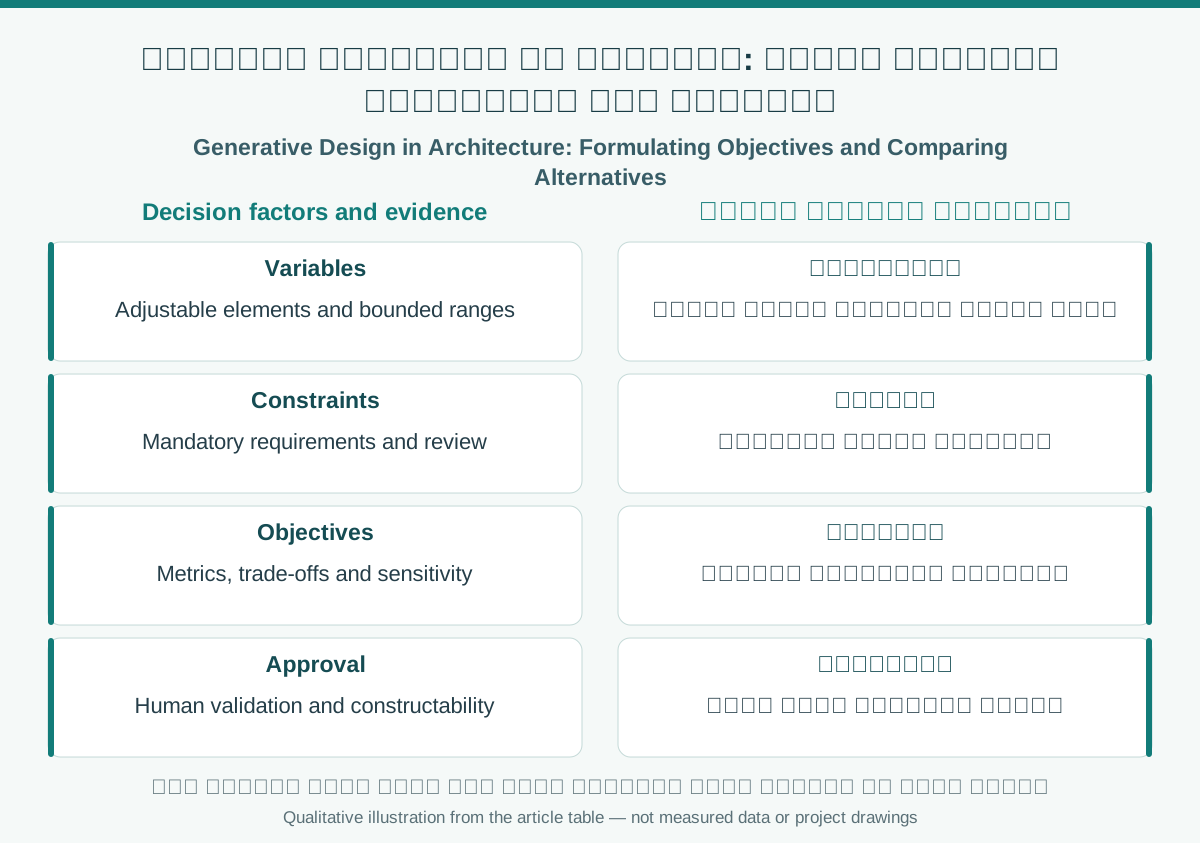
| Factor | Evidence or action |
|---|---|
| Variables | Adjustable elements and bounded ranges |
| Constraints | Mandatory requirements and review |
| Objectives | Metrics, trade-offs and sensitivity |
| Approval | Human validation and constructability |
A visual reading of the article topic
- 01Constraints and objectives before generating solutions
- 02Pareto trade-offs and quality review
- 03Tool selection and integration into practice
- 04Comparison and verification table
Practical workflow
- 01 Formulate design problem
- 02 Define constraints and objectives
- 03 Generate alternatives and test trade-offs
- 04 Approve after review
Conceptual editorial diagram; not measured data.
Sources and limitations
Editorial adaptation based on the original WordPress archive; original source retained separately. Numerical examples are hypothetical. Software features, availability and licensing from 2021 require vendor verification; this is not a current tool ranking.
Topics and source excerpts
| Topic | Excerpt from article |
|---|---|
| Constraints and objectives before generating solutions | The source presents generative design as exploring outcomes using variables and constraints. |
| Pareto trade-offs and quality review | The source discusses historical tools including Fusion 360, Archistar, Octopus and Galapagos. |
| Tool selection and integration into practice | Define the output and its compatibility with information models and project documentation. |
| Practical workflow | 01 Formulate design problem |
| Sources and limitations | Editorial adaptation based on the original WordPress archive; original source retained separately. |
| References and limitations | Define goals, constraints and inputs before generating alternatives, then review results and revise assumptions. |
Source excerpts organized for comparison, not newly researched findings.
References and limitations
Define goals, constraints and inputs before generating alternatives, then review results and revise assumptions. Algorithmic ranking does not establish structural or regulatory suitability.
The following references support selected topics in the article.
Autodesk Revit 2026 — About Generative Design