From Industry 4.0 to construction
The article introduces Construction 4.0 as an extension of Industry 4.0 into the built environment. Transformation extends beyond digital drawing to information exchange, data-assisted fabrication and performance monitoring. Start with a practical problem such as interdisciplinary conflicts or material waste, rather than buying technology without purpose.
Automation, materials and sustainability
Computational tools explore design options, and automation may support repetitive tasks such as generating stair details under constraints. Outputs still require code, functional and safety review. The source also discusses self-healing materials and biomimicry; readiness and performance evidence vary, and each material requires application-specific tests and approvals.
Connected operation and risk
Sensor data and predictive maintenance may detect deterioration signals, but buildings cannot be assumed to repair themselves or predict climate with absolute accuracy. Collaborate with data, materials, structural and operations specialists, defining information ownership and approval responsibility. Compare results through life-cycle cost and risk before scaling.
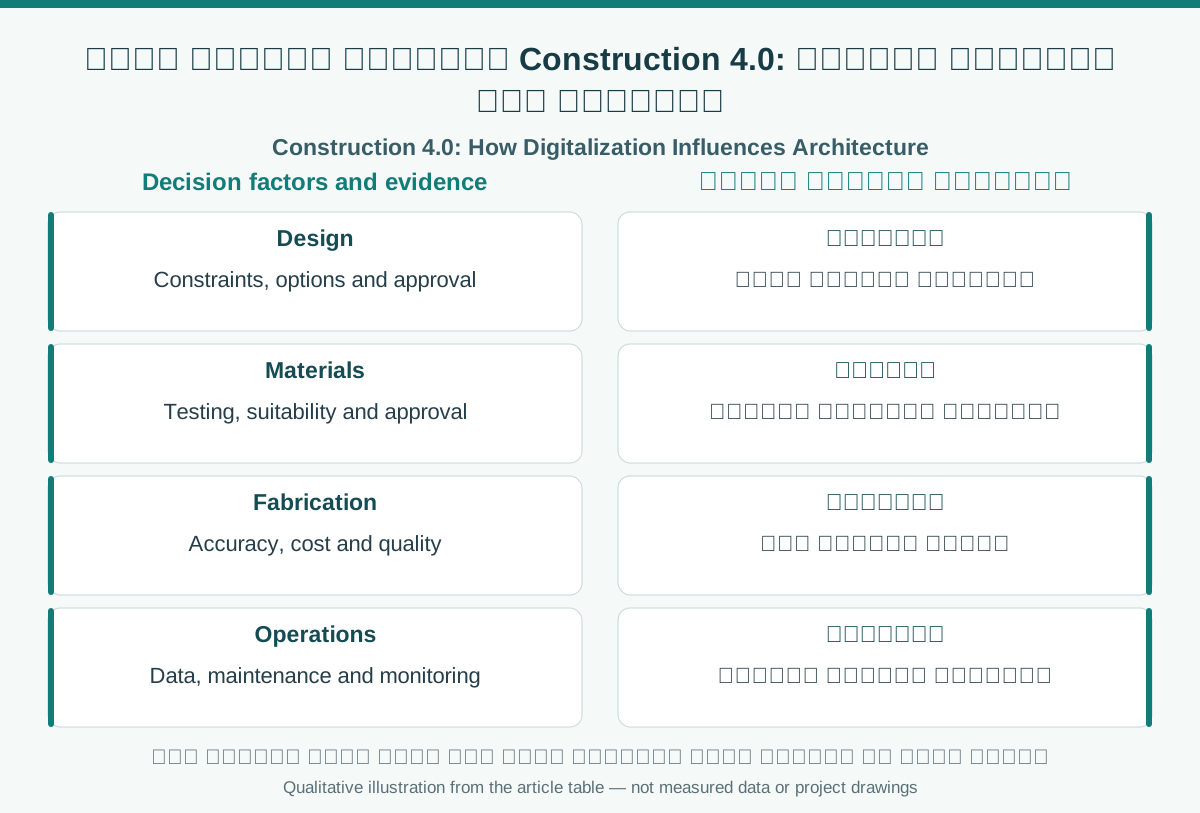
Decision review table
| Factor | Evidence or action |
|---|---|
| Design | Constraints, options and approval |
| Materials | Testing, suitability and approval |
| Fabrication | Accuracy, cost and quality |
| Operations | Data, maintenance and monitoring |
A visual reading of the article topic
- 01From Industry 4.0 to construction
- 02Automation, materials and sustainability
- 03Connected operation and risk
- 04Decision review table
Practical workflow
- 01 Identify project problem
- 02 Select suitable digital solution
- 03 Validate outputs
- 04 Measure life-cycle performance
Conceptual editorial diagram; not measured data.
Sources and limitations
Editorial adaptation based on the original WordPress archive; original source retained separately. Company and project examples from 2020 and material and prediction claims require independent technical evidence; they are not presented as universally mature or available.
Topics and source excerpts
| Topic | Excerpt from article |
|---|---|
| From Industry 4.0 to construction | The article introduces Construction 4.0 as an extension of Industry 4.0 into the built environment. |
| Automation, materials and sustainability | Computational tools explore design options, and automation may support repetitive tasks such as generating stair details under constraints. |
| Connected operation and risk | Sensor data and predictive maintenance may detect deterioration signals, but buildings cannot be assumed to repair themselves or predict climate with absol… |
| Practical workflow | 01 Identify project problem |
| Sources and limitations | Editorial adaptation based on the original WordPress archive; original source retained separately. |
| References and limitations | Open information standards and alternative-generation tools serve defined workflows, with application-specific robot and AI risk assessment. |
Source excerpts organized for comparison, not newly researched findings.
References and limitations
Open information standards and alternative-generation tools serve defined workflows, with application-specific robot and AI risk assessment. Digitalization alone does not establish sustainability or safety.
The following references support selected topics in the article.
- buildingSMART — openBIM
- Autodesk Revit 2026 — About Generative Design
- OSHA Technical Manual, industrial robot systems
- NIST AI RMF