Setting and cultural role
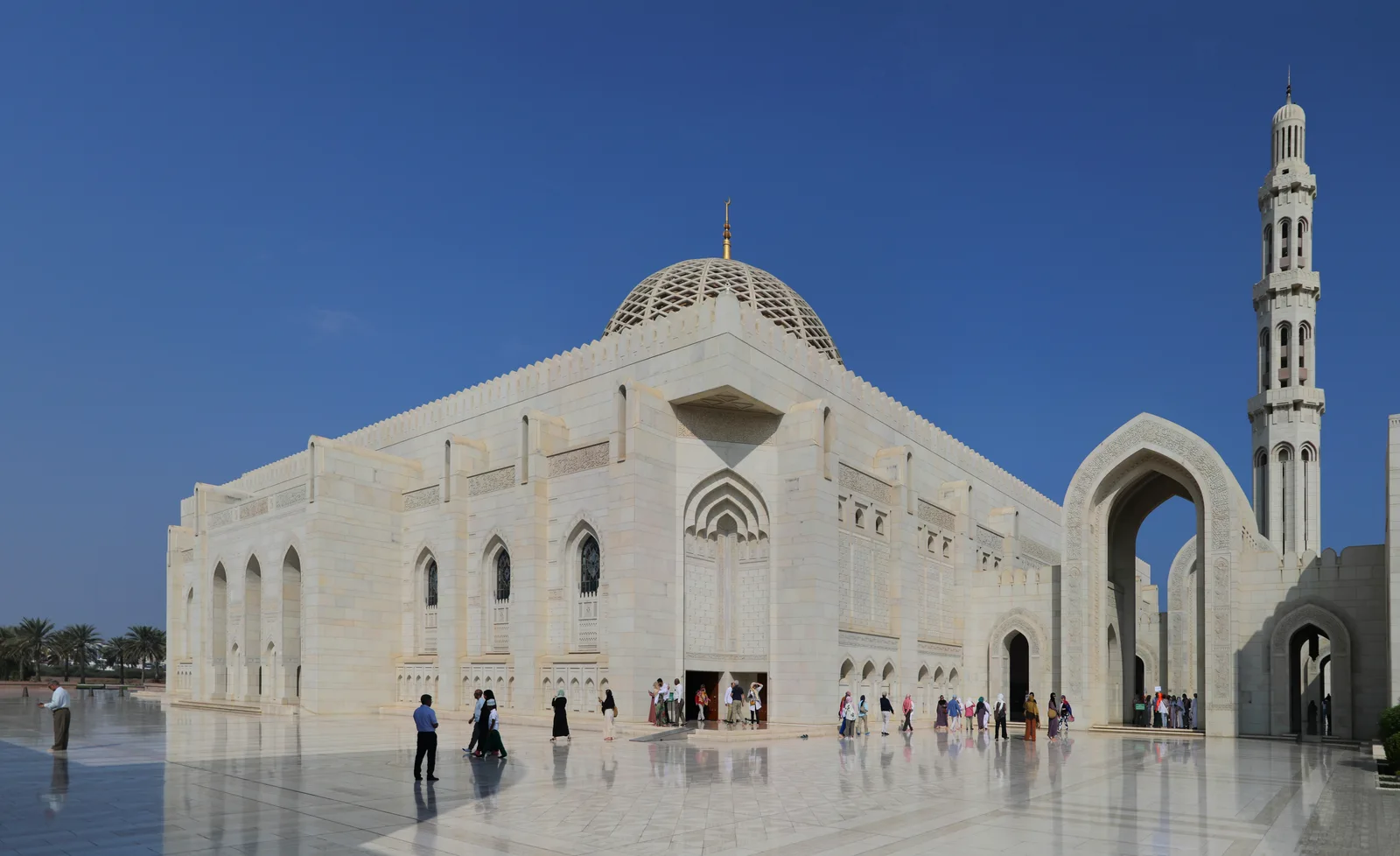
The source describes Sultan Qaboos Grand Mosque in Muscat, Oman, as a landmark linking worship, learning and Islamic identity. Read its architecture through the site, external paths, arrival and transition into devotional spaces. Analyze its civic and architectural presence beyond size and decoration. Precise historical study requires documented project phases and design and construction sources.
Composition, spaces and circulation
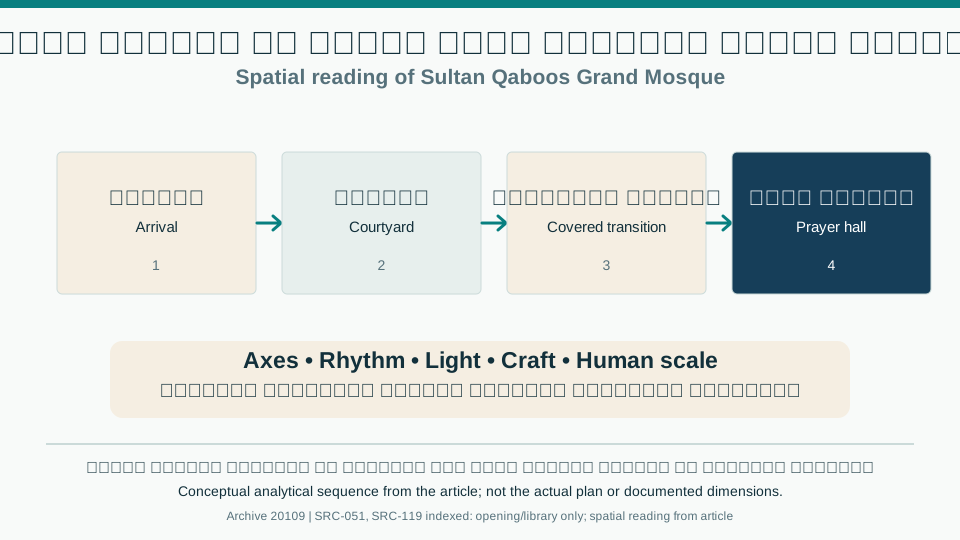
The source discusses entrances, arcades, courtyards, the main prayer hall, dome and minarets. These create transitions between open and covered spaces; axes, repetition and rhythm can guide movement and organize views. The prayer hall relates to qibla orientation and prayer rows, while entrances and transition areas support use. Read the dome as a dominant vertical element without deriving dimensions or structure from photographs alone.
Materials, ornament and light
The source describes carpets, inscriptions, geometric patterns, materials, craftsmanship, library and educational facilities. Close reading reveals human scale and relationships between surface, light, color and pattern, and between craft and worship space. Separate direct observations from claims about materials, artisan counts and production times. Field study should respect worship, visitor and photography rules, document image and measurement sources and establish the actual function of cultural facilities.
Comparison and verification table
| Factor | Evidence or action |
|---|---|
| Arrival | Axes, entrances and transitions |
| Space | Courtyard, arcade and prayer hall |
| Composition | Dome, minarets and rhythm |
| Identity | Ornament, craft and learning |
A visual reading of the article topic
- 01Setting and cultural role
- 02Composition, spaces and circulation
- 03Materials, ornament and light
- 04Comparison and verification table
Practical workflow
- 01 Document site and sources
- 02 Analyze circulation and composition
- 03 Read materials and light
- 04 Verify historical facts
Conceptual editorial diagram; not measured data.
Topics and source excerpts
| Topic | Excerpt from article |
|---|---|
| Setting and cultural role | The source describes Sultan Qaboos Grand Mosque in Muscat, Oman, as a landmark linking worship, learning and Islamic identity. |
| Composition, spaces and circulation | The source discusses entrances, arcades, courtyards, the main prayer hall, dome and minarets. |
| Materials, ornament and light | The source describes carpets, inscriptions, geometric patterns, materials, craftsmanship, library and educational facilities. |
| Practical workflow | 01 Document site and sources |
| Sources and limitations | Editorial adaptation based on the original WordPress archive; original source retained separately. |
Source excerpts organized for comparison, not newly researched findings.
Sources and limitations
Editorial adaptation based on the original WordPress archive; original source retained separately. Historical construction dates, design attribution, dimensions, capacity, materials, visit hours and carpet figures need official verification and are not adopted as precise facts or current visitor guidance.
- Sultan Qaboos Higher Centre for Culture and Science: Grand Mosque Library — Indexed official library text dates the mosque opening to 4 May 2001; not evidence of design details or dimensions.
- Sultan Qaboos Higher Centre for Culture and Science: Grand Mosque Library — Arabic — Indexed official Arabic text corroborates opening date and library cultural and information functions; not its position relative to the entrance or design specifications.