Market and land stage
Start with a hypothesis defining the customer segment, need, product and affordable price. Test demand through comparable contracts, occupancy, inventory and interviews; latent demand is a hypothesis, not established by high rents alone. Check land rights, use, restrictions, infrastructure, access, ground conditions and hazards. Distinguish announced infrastructure from funding, delivery and actual operation rather than relying on expected land appreciation.
Design, feasibility and finance stage
Translate needs into an architectural brief and usable areas, then compare options for income, cost, quality and flexibility. Value engineering examines required functions and life-cycle costs rather than simply reducing specifications. Prepare estimates of costs, schedule, cash flows and contingency, verifying funding sources, drawdown and repayment conditions before commitment. Do not treat expected future sales as available cash without clear timing and conditions.
Construction, handover and operations stage
Define responsibilities for design, approvals, procurement, construction and quality control, retaining change decisions and cost and schedule effects. Link construction-stage payments to documented works and appropriate tests. At handover, verify conformity, commissioning, documentation, warranties and maintenance plans, then monitor occupancy, sales and user satisfaction against feasibility assumptions. Advance stages when criteria are met, not merely when a planned duration expires.
Decision review table
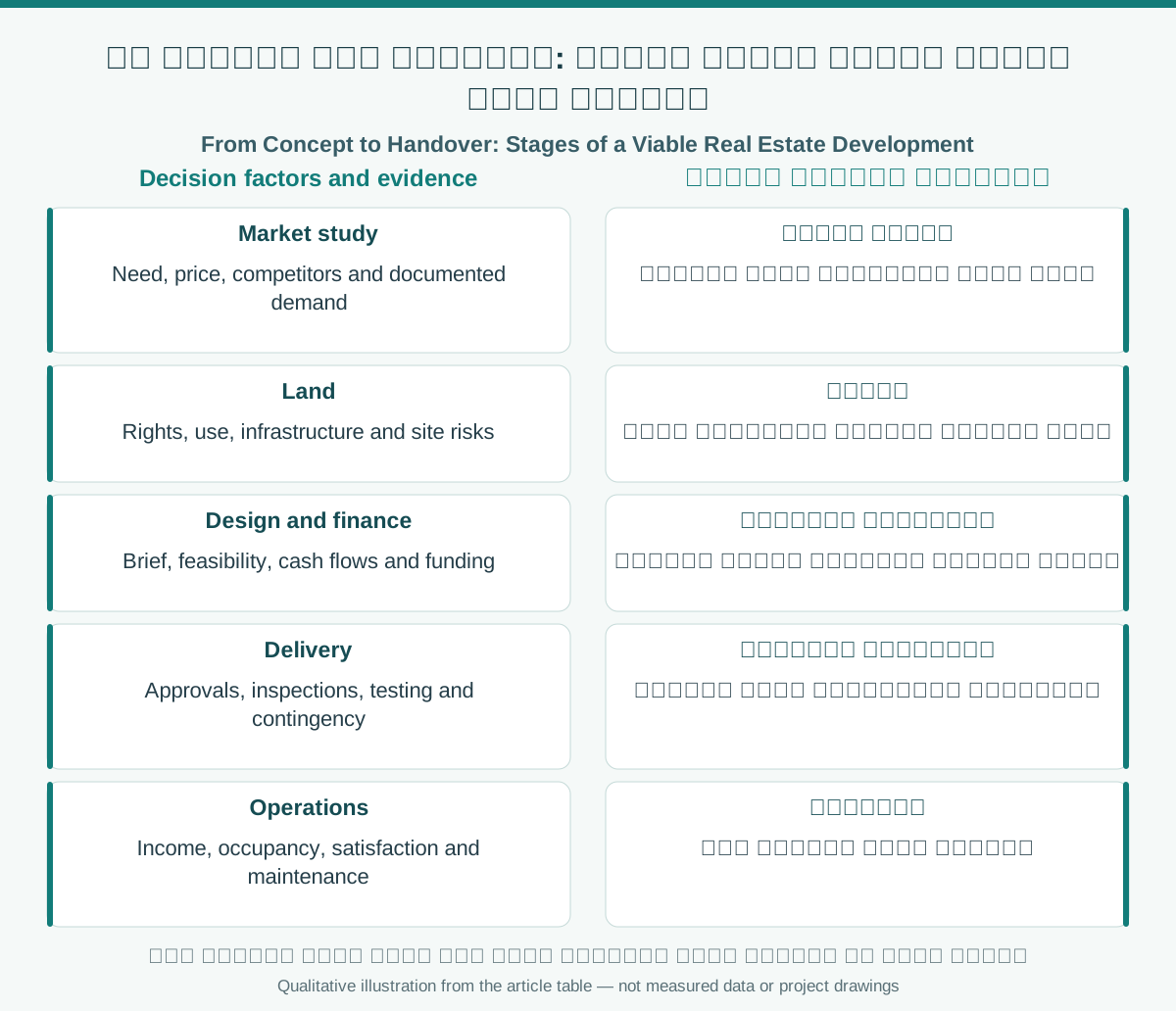
| Factor | Evidence or action |
|---|---|
| Market study | Need, price, competitors and documented demand |
| Land | Rights, use, infrastructure and site risks |
| Design and finance | Brief, feasibility, cash flows and funding |
| Delivery | Approvals, inspections, testing and contingency |
| Operations | Income, occupancy, satisfaction and maintenance |
A visual reading of the article topic
- 01Market and land stage
- 02Design, feasibility and finance stage
- 03Construction, handover and operations stage
- 04Decision review table
Practical workflow
- 01 Test concept and market
- 02 Validate land
- 03 Approve brief and feasibility
- 04 Verify funding and requirements
- 05 Build and control quality
- 06 Hand over and measure performance
Conceptual editorial diagram; not measured data.
Sources and limitations
Editorial development based on the original Emlak source; previous text retained. The original value-engineering savings percentage requires documentation; following stages does not guarantee success or land appreciation. Regulatory requirements vary by project and location.
Topics and source excerpts
| Topic | Excerpt from article |
|---|---|
| Market and land stage | Start with a hypothesis defining the customer segment, need, product and affordable price. |
| Design, feasibility and finance stage | Translate needs into an architectural brief and usable areas, then compare options for income, cost, quality and flexibility. |
| Construction, handover and operations stage | Define responsibilities for design, approvals, procurement, construction and quality control, retaining change decisions and cost and schedule effects. |
| Practical workflow | 01 Test concept and market |
| Sources and limitations | Editorial development based on the original Emlak source; previous text retained. |
| References and limitations | Stage transitions depend on feasibility, designs, costs, cash flows and required approvals, especially for applicable off-plan projects. |
Source excerpts organized for comparison, not newly researched findings.
References and limitations
Stage transitions depend on feasibility, designs, costs, cash flows and required approvals, especially for applicable off-plan projects.
The following references support selected topics in the article.
- Homes England financial viability guidance
- REGA Off-Plan Sale and Lease Law