Start with the brief, not plot shape
The article discusses plot shape, location, orientation and access to services. Define users, functions, area needs, budget and future flexibility. Square plots may suit one brief while rectangular plots suit another, depending on dimensions, setbacks, orientation and regulations. Corner plots are not automatic choices: they may offer views and access or introduce noise, privacy issues and building restrictions.
Location, climate and technical checks
Measure actual travel times to work, schools and services, reviewing walking networks, traffic, noise and potential development. Analyze seasonal sun, winds, shade and privacy for the specific location; no universal best orientation exists. Obtain a survey and appropriate studies of soil, groundwater, slope and flood hazards. Some constrained plots remain developable if engineering solutions and costs are established.
Title and financial comparison
Match boundaries, area, identifier and seller authority with official records, checking encumbrances, restrictions, use and utilities. Compare total land, preparation, design, construction, connection and contingency costs rather than unit price alone. A scoring matrix can separate mandatory requirements from trade-offs in access, shape and cost. A high score cannot compensate for missing legal title or unsafe site conditions.
Comparison and verification table
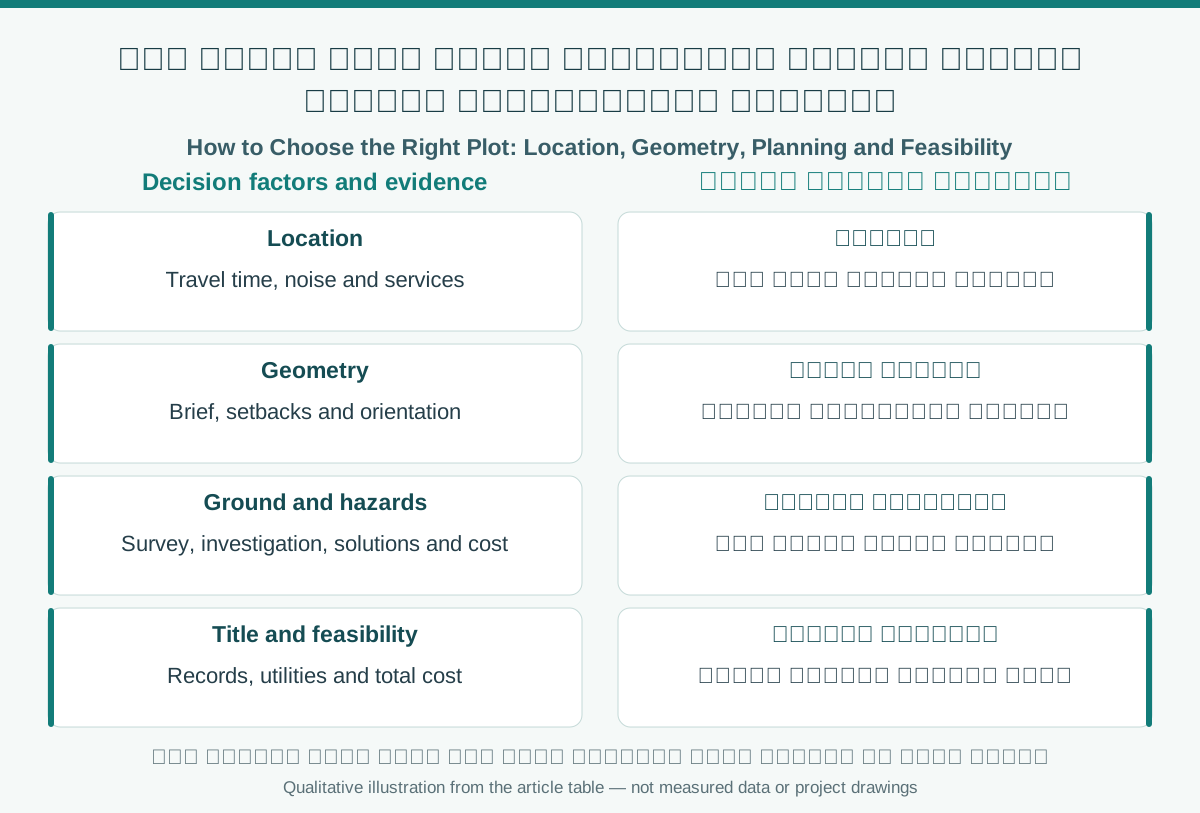
| Factor | Evidence or action |
|---|---|
| Location | Travel time, noise and services |
| Geometry | Brief, setbacks and orientation |
| Ground and hazards | Survey, investigation, solutions and cost |
| Title and feasibility | Records, utilities and total cost |
A visual reading of the article topic
- 01Start with the brief, not plot shape
- 02Location, climate and technical checks
- 03Title and financial comparison
- 04Comparison and verification table
Practical workflow
- 01 Define mandatory requirements
- 02 Compare sites and options
- 03 Verify title, ground and regulations
- 04 Decide using whole-project feasibility
Conceptual editorial diagram; not measured data.
Sources and limitations
Editorial adaptation based on the original WordPress archive; original source retained separately. Historical orientation, street-width and plot-shape recommendations are not universal rules. Site-specific technical and regulatory review is necessary; the original video is preserved.
Topics and source excerpts
| Topic | Excerpt from article |
|---|---|
| Start with the brief, not plot shape | The article discusses plot shape, location, orientation and access to services. |
| Location, climate and technical checks | Measure actual travel times to work, schools and services, reviewing walking networks, traffic, noise and potential development. |
| Title and financial comparison | Match boundaries, area, identifier and seller authority with official records, checking encumbrances, restrictions, use and utilities. |
| Practical workflow | 01 Define mandatory requirements |
| Sources and limitations | Editorial adaptation based on the original WordPress archive; original source retained separately. |
| References and limitations | Separate geometric/climatic suitability from development rights; verify registry, survey and official requirements before financial comparison and design. |
Source excerpts organized for comparison, not newly researched findings.
References and limitations
Separate geometric/climatic suitability from development rights; verify registry, survey and official requirements before financial comparison and design.
The following references support selected topics in the article.
- REGA — Law of Real Estate Registration, arts 7–8
- REGA — Real Estate Registry official platform description
- National Platform — Issuing a Building Permit
- MOMAH — Updated requirements for residential buildings, 16 July 2024