
Start with investment objective and market
The source discusses population, economy, major projects, infrastructure and financing in Saudi Arabia. Effects vary by city, neighborhood, asset type, competing supply and project stage. Define investment purpose, horizon, risk tolerance and liquidity needs before choosing a location. Review actual transactions, rents, vacancy, future supply and financing with dates and sources; a major project announcement alone does not establish price growth for a particular asset.
Asset assessment and valuation approaches
Check ownership, boundaries, restrictions, permitted use, condition, construction, services, access and existing leases. Valuation can use a market approach with adjusted comparables, an income approach with cash flows and risk assumptions, or a cost approach considering land, replacement or reproduction cost and depreciation as appropriate. Suitability varies by asset, purpose and evidence. Asking prices are not completed sales, and cost does not necessarily equal market value.
Feasibility and risk testing
Estimate income after vacancy, expenses, maintenance and management; review acquisition, financing, fees, possible taxes, major replacements and exit costs. Stress-test lower rents, higher costs, delayed occupancy or sale, and compare cash flows with obligations and risk capacity. Obtain independent inspections and professional valuation when needed and verify applicable rules before contracting. Do not base an investment on one profit forecast or unadjusted price-per-area comparisons.
Comparison and verification table
| Factor | Evidence or action |
|---|---|
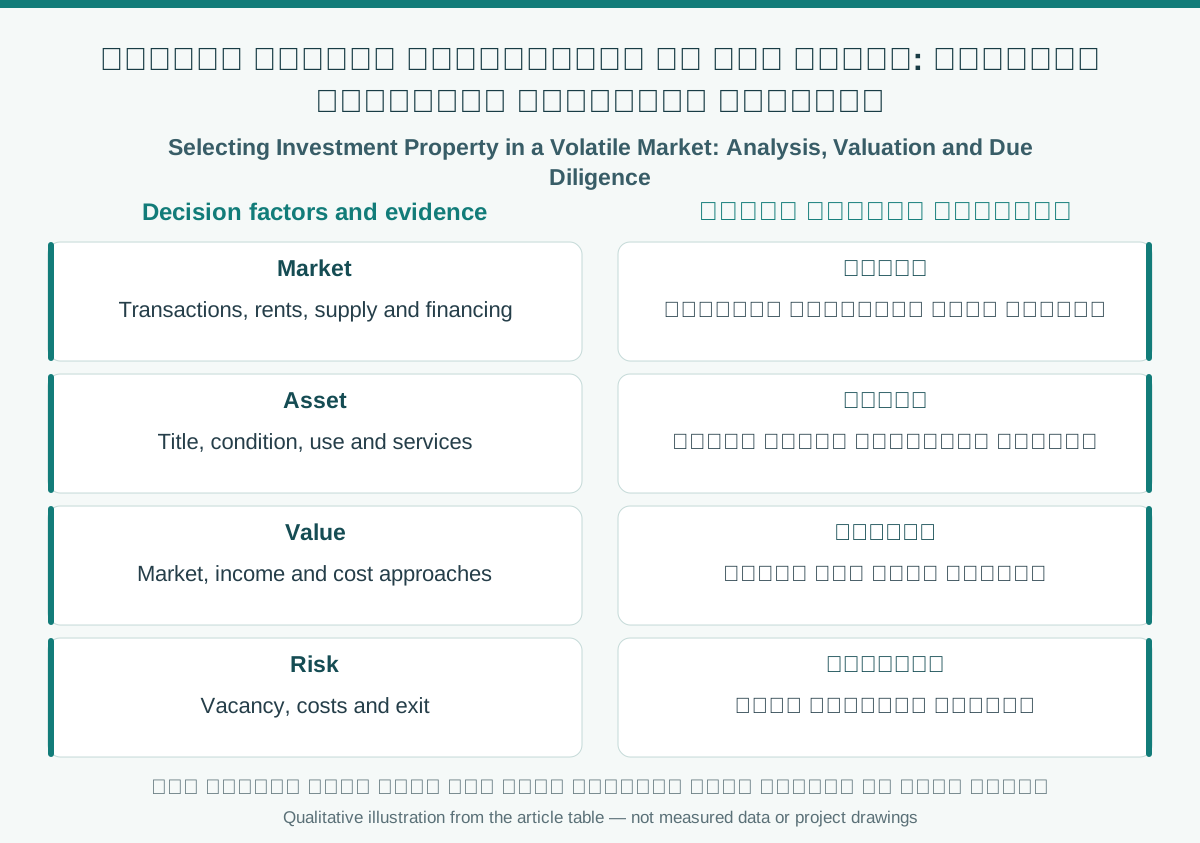
| Market | Transactions, rents, supply and financing |
| Asset | Title, condition, use and services |
| Value | Market, income and cost approaches |
| Risk | Vacancy, costs and exit |
A visual reading of the article topic
- 01Start with investment objective and market
- 02Asset assessment and valuation approaches
- 03Feasibility and risk testing
- 04Comparison and verification table
Practical workflow
- 01 Define objective and capacity
- 02 Verify market and asset
- 03 Compare valuation and scenarios
- 04 Decide after due diligence
Conceptual editorial diagram; not measured data.
Sources and limitations
Editorial adaptation based on the original WordPress archive; original source retained separately. Historical areas and projects are not current investment recommendations or return guarantees; current market, legal and financing data and suitable valuation are required.
Topics and source excerpts
| Topic | Excerpt from article |
|---|---|
| Start with investment objective and market | The source discusses population, economy, major projects, infrastructure and financing in Saudi Arabia. |
| Asset assessment and valuation approaches | Check ownership, boundaries, restrictions, permitted use, condition, construction, services, access and existing leases. |
| Feasibility and risk testing | Estimate income after vacancy, expenses, maintenance and management; review acquisition, financing, fees, possible taxes, major replacements and exit costs… |
| Practical workflow | 01 Define objective and capacity |
| Sources and limitations | Editorial adaptation based on the original WordPress archive; original source retained separately. |
| References and limitations | Use dated market indicators and purpose/date-specific professional valuation, verifying rights, taxes and restrictions before feasibility testing. |
Source excerpts organized for comparison, not newly researched findings.
References and limitations
Use dated market indicators and purpose/date-specific professional valuation, verifying rights, taxes and restrictions before feasibility testing. Indicators are not purchase recommendations.
The following references support selected topics in the article.
- REGA — Real Estate Indicators
- TAQEEM — Real estate valuation sector
- REGA — Real Estate Registry official platform description
- ZATCA — Real Estate Transaction Tax Law