

How finance costs affect demand
Financing rates and credit conditions can affect monthly payments and purchasing power. Responses vary with fixed or variable contractual costs, income, existing debts, down payment and term. Lower financing costs do not automatically lower home prices; they may increase demand where supply is constrained. Compare actual financing costs rather than the monetary indicator alone.
Housing support and household budget
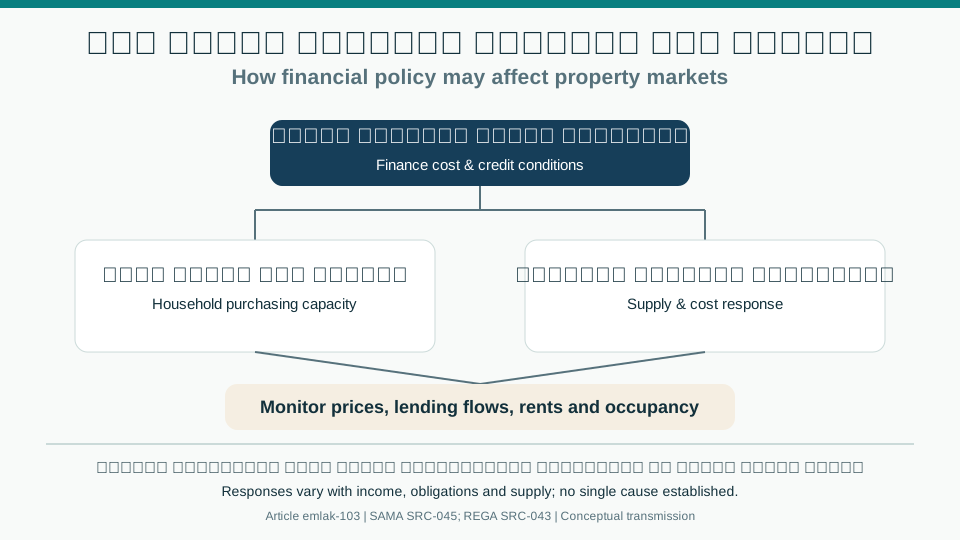
Targeted support may help eligible households address down-payment or cost barriers, but effects depend on program terms and supply and price responses. Stress-test household budgets after living expenses, maintenance and reserves. Compare like-for-like offers by amount, term and total cost, reviewing potential payment or fee changes. Approval does not establish sustainable repayment.
Evaluating policy at market level
Distinguish outstanding loan balances from new financing volumes and contract counts; outstanding balances may rise while new lending slows. Monitor property prices, rents, income, construction costs and occupancy by sector and city. Evaluate policies against their goals, measured outcomes and risks to borrowers, lenders and supply, without attributing market change solely to oil or rates.
Decision review table
| Factor | Evidence or action |
|---|---|
| Financing cost | Comparable offers and total cost |
| Credit | Separate outstanding and new lending |
| Support | Eligibility, targeting and affordability impact |
| Supply | Construction costs, inventory and delivery |
A visual reading of the article topic
- 01How finance costs affect demand
- 02Housing support and household budget
- 03Evaluating policy at market level
- 04Decision review table
Practical workflow
- 01 Identify policy and period
- 02 Separate indicators
- 03 Test household and developer impacts
- 04 Review outcomes and risks
Conceptual editorial diagram; not measured data.
Topics and source excerpts
| Topic | Excerpt from article |
|---|---|
| How finance costs affect demand | Financing rates and credit conditions can affect monthly payments and purchasing power. |
| Housing support and household budget | Targeted support may help eligible households address down-payment or cost barriers, but effects depend on program terms and supply and price responses. |
| Evaluating policy at market level | Distinguish outstanding loan balances from new financing volumes and contract counts; outstanding balances may rise while new lending slows. |
| Practical workflow | 01 Identify policy and period |
| Sources and limitations | Editorial development based on the author’s original Emlak article; previous text retained. |
Source excerpts organized for comparison, not newly researched findings.
Sources and limitations
Editorial development based on the author’s original Emlak article; previous text retained. Q1 2025 loan figures and growth rates require reconciliation with Saudi Central Bank definitions and tables. Proposed support or rate-fixing measures are not presented as operative policies without verification.
- SAMA: Responsible Lending Principles for Individual Customers — Total payable, variable term cost, obligations, disposable income and expenses in affordability assessment; quantitative limits and individual conditions require separate checks.
- REGA: Real Estate Indicators Platform — Distinguishes transaction count, value, area, mean transaction value, outstanding loan balances and new individual residential finance; no numerical series or forecast adopted.