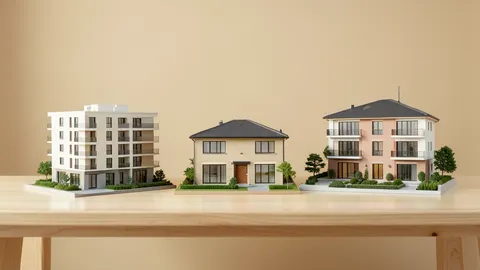
Impression, belonging and function
The first factors are façade and entrance, neighborhood belonging, and balance between appearance and function. Testing entrances, circulation and furniture layouts can reveal what customers readily understand and what confuses them. Aesthetic preferences are not uniform; they depend on culture, age, household and use context.
Light, imagined life and identity
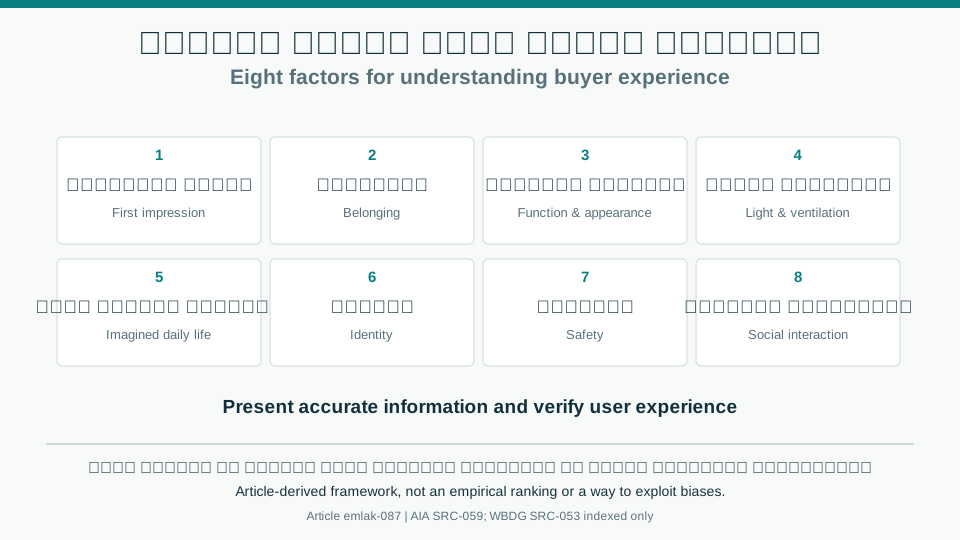
Further factors include daylight and ventilation, the buyer’s ability to imagine everyday activities, and cultural or architectural identity. Provide clear drawings and realistically scaled furnished models, explaining orientation, views and constraints. Assess comfort with suitable methods rather than visual impressions alone, and never present a simulation as a delivered condition.
Safety and social interaction
The final factors are physical and perceived safety, and opportunities for human interaction in shared spaces. Separate subjective impressions from verified safety and accessibility requirements, and balance meeting spaces with privacy. Collect voluntary feedback and compare it with observed use and specifications; the purpose is to help customers decide, not exploit biases.
Decision review table
| Factor | Evidence or action |
|---|---|
| First impression | Entrance clarity and arrival experience |
| Belonging | Neighborhood fit for household needs |
| Function and appearance | Circulation, dimensions and use |
| Light and ventilation | Comfort, glare and air assessment |
| Imagined everyday life | Realistic furniture and activity scenarios |
| Identity | Diverse cultural preferences |
| Safety | Access, lighting and safety requirements |
| Social interaction | Shared spaces with privacy |
A visual reading of the article topic
- 01Impression, belonging and function
- 02Light, imagined life and identity
- 03Safety and social interaction
- 04Decision review table
Practical workflow
- 01 Understand users
- 02 Test spatial experience
- 03 Present information accurately
- 04 Review resident feedback
Conceptual editorial diagram; not measured data.
Topics and source excerpts
| Topic | Excerpt from article |
|---|---|
| Impression, belonging and function | The first factors are façade and entrance, neighborhood belonging, and balance between appearance and function. |
| Light, imagined life and identity | Further factors include daylight and ventilation, the buyer’s ability to imagine everyday activities, and cultural or architectural identity. |
| Safety and social interaction | The final factors are physical and perceived safety, and opportunities for human interaction in shared spaces. |
| Practical workflow | 01 Understand users |
| Sources and limitations | Editorial development based on the author’s original Emlak article; previous text retained. |
Source excerpts organized for comparison, not newly researched findings.
Sources and limitations
Editorial development based on the author’s original Emlak article; previous text retained. The factors form an analytical framework derived from the article, not a fixed empirical ranking of purchase drivers; psychological or sales effects require appropriate research.
- WBDG: Architectural Programming — Indexed corroboration of goals, functions, activities, costs and timing; staging link stability unconfirmed, prefer complementary readable sources. No universal psychological or sales effect established.
- AIA: A Problem Well Stated — Owner Project Requirements — Practitioner guidance on brief, site, function, performance and cost; not code approval or a guarantee of project outcomes.